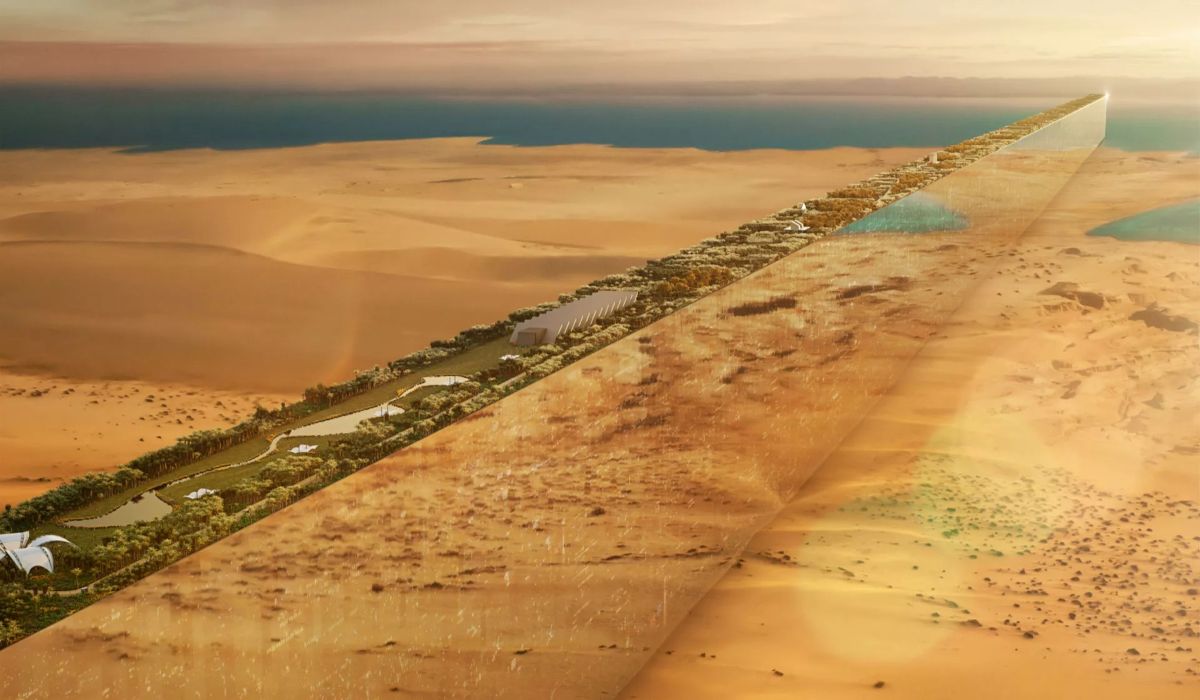
When your megacity costs balloon to 25 times your country’s annual budget, you know something’s gone spectacularly wrong. Saudi Arabia’s The Line—originally pitched as a 170-kilometer mirror-wrapped linear city for 9 million residents—officially hit the brakes in September 2025 after burning through $50 billion on what amounts to a very expensive trench in the desert.
Reality Check Arrives via Audit Leak
Internal documents revealed deliberate financial manipulation and impossible cost projections.
The Wall Street Journal obtained leaked internal audits showing The Line’s true projected cost: $8.8 trillion by 2080. That’s not a typo—it’s nearly incomprehensible financial fantasy involving “deliberate manipulation” of revenue models, including inflated hotel rates that made Disney World look budget-friendly. The 170-kilometer dream shrunk to a potential 2.5-kilometer reality, with completion pushed to 2045 at earliest.
Human Cost Behind the Hype
Displaced communities and worker deaths reveal the project’s brutal reality.
The Huwaitat tribe was forcibly relocated from their ancestral lands, with resisters arrested or killed—including Abdul Rahim al-Huwaiti in 2020. Reports suggest 21,000 migrant worker deaths since Vision 2030 began, though authorities dispute these figures. When your urban planning requires ethnic cleansing, you’ve probably missed the mark on “sustainable living.”
Desert Data Centers Rise from City Ruins
A $5 billion AI infrastructure deal transforms failure into tech opportunity.
Here’s where the story gets interesting: that expensive trench isn’t going to waste. DataVolt signed a $5 billion deal to build AI infrastructure in NEOM’s industrial district, operational by 2028. The facilities will use Red Sea seawater for net-zero cooling—no precious fresh water required—powered entirely by NEOM’s renewable energy grid. It’s the kind of pragmatic pivot that actually makes sense in a region competing with AWS Middle East and Google Cloud UAE for AI supremacy.
Gulf AI Arms Race Intensifies
Saudi Arabia positions itself as the Middle East’s low-latency AI hub.
This isn’t just about salvaging a failed megaproject—it’s about regional AI dominance. The Gulf’s energy abundance and strategic location create ideal conditions for hyperscale GPU computing, especially for latency-sensitive workloads serving European and Asian markets. If you’re tracking Middle East tech infrastructure, this pivot signals Saudi Arabia’s shift from impossible urban fantasies to achievable digital infrastructure that could genuinely compete.
Sometimes the best urban planning is admitting when you’ve planned wrong.