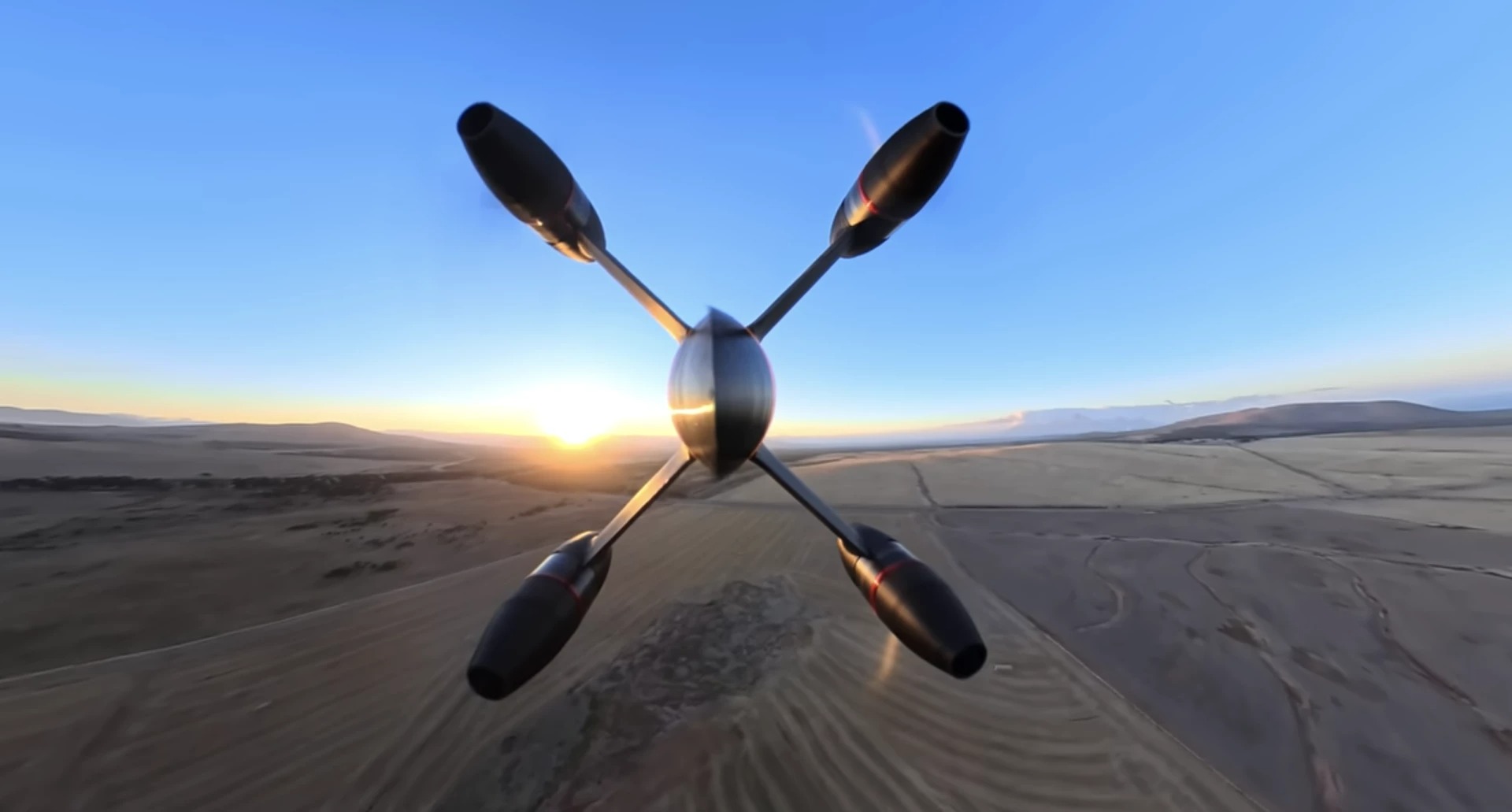
Dead phone batteries during emergencies are frustrating, but imagine your DIY drone outrunning a French TGV bullet train. The Peregreen V4, built by South African father-son duo Mike and Luke Bell, just claimed the Guinness World Record for fastest battery-powered quadcopter at 657 km/h (408 mph) average speed on December 11, 2025, near Cape Town. Your garage workshop suddenly seems more promising.
Consumer Tech Meets Extreme Engineering
The Bells printed their record-breaker’s entire frame on a Bambu Lab H2D—the same consumer printer you’d find in makespaces worldwide. They combined PETG for structure, carbon fiber-reinforced PA6-CF for strength, and flexible TPU for impact resistance. No joints, no assembly headaches, just one smooth piece optimized for airflow.
Four T-Motor 3120 brushless motors (900 kV) spin hand-trimmed 15-centimeter propellers while LiPo batteries deliver the brutal power demands. The frame got hand-sanded carbon fiber reinforcements where stress concentrates most.
Third Time’s the Charm
This wasn’t beginner’s luck. The Bells previously hit 480 km/h with Peregreen 2 in June 2024, then 585 km/h with Peregreen 3 last October—each iteration teaching them something new about extreme aerodynamics. AirShaper CFD simulations helped balance lift, drag, and stability while Guinness protocols demanded two opposite-direction runs to neutralize wind effects.
The December 11th flight averaged that record 657 km/h, with individual runs hitting 658-659 km/h downwind and 599 km/h upwind. Previous record holder Ben Biggs’ Blackbird topped out at 626 km/h.
When Hobby Engineering Goes Hypersonic
Your typical racing drone tops out around 200 km/h on a good day. The Peregreen V4 travels faster than most commercial aircraft at cruising altitude, approaching the realm where air starts behaving very differently. Flight times remain brutally short—these batteries and motors weren’t designed for sustained punishment.
But as proof of concept? The Bells just demonstrated that extreme performance doesn’t require corporate R&D budgets, just persistence and smart engineering. The maker revolution keeps pushing boundaries you didn’t think possible from your desk.