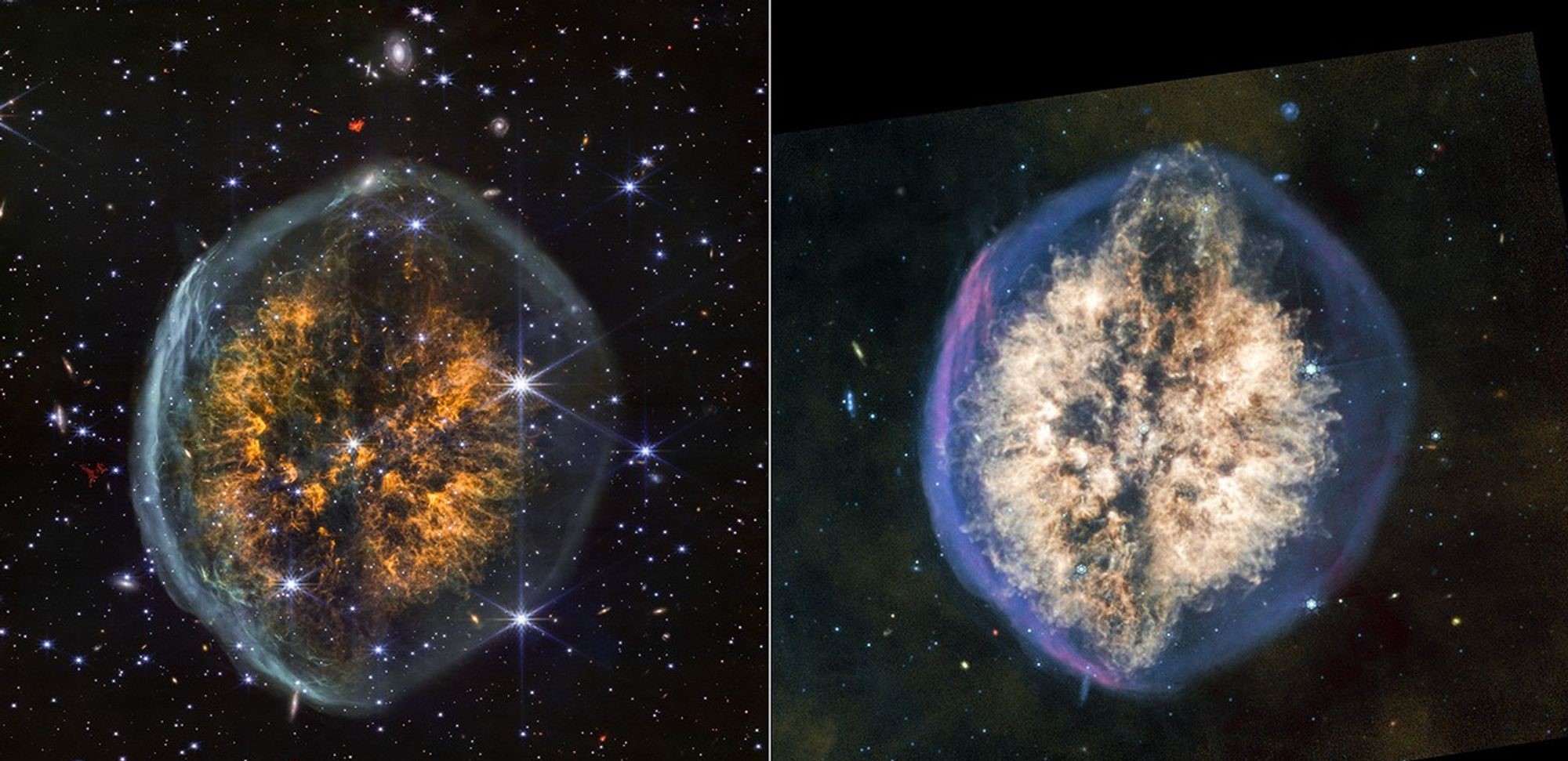
Your brain on cosmic steroids looks remarkably like PMR 1, a dying star’s final masterpiece captured by NASA’s Webb telescope. Located 5,000 light-years away in the Vela constellation, this planetary nebula earned its “Exposed Cranium” nickname for obvious reasons — it genuinely resembles a translucent skull housing a detailed brain. Webb’s infrared vision reveals what the Spitzer telescope glimpsed over a decade ago but couldn’t fully resolve: a star’s death throes creating accidental neuroscience art.
The nebula’s brain-like structure emerges from stellar physics, not cosmic coincidence. An outer hydrogen shell — the “skull” — surrounds an inner cloud of heavier gases that form the brain’s intricate folds. A dark vertical lane divides the structure into distinct hemispheres, likely created by twin jets of material blasting from the central star in opposite directions.
Webb’s dual instruments capture complementary perspectives: NIRCam reveals background stars shining through the transparent gas, while MIRI highlights cosmic dust and material ejection at the nebula’s extremities. This multi-wavelength approach lets you see different temperature regimes and dust penetration levels that single observations miss.
This 3.5-light-year-wide structure captures a cosmically brief moment in stellar evolution. You’re witnessing a star shedding its outer layers before its final act — but astronomers can’t predict the ending. The central star might explode as a supernova or quietly become a white dwarf like our Sun eventually will.
That uncertainty underscores how much remains mysterious about stellar death, even with Webb’s unprecedented capabilities.
Webb’s resolution transforms how you experience distant cosmic events. Where Spitzer detected a fuzzy infrared blob, Webb reveals architectural details that make stellar death feel tangible. The color-composite images assign visible light to infrared data from multiple filters, creating brain imagery that bridges the gap between abstract astrophysics and visceral human recognition.
Each observation strengthens Webb’s reputation as astronomy’s most powerful storyteller.
This discovery exemplifies how advanced space technology turns cosmic processes into accessible wonder. PMR 1 won’t change stellar evolution theory, but it demonstrates how the universe creates beauty from destruction — and how the right tools can make you see familiar patterns in the most unexpected places.