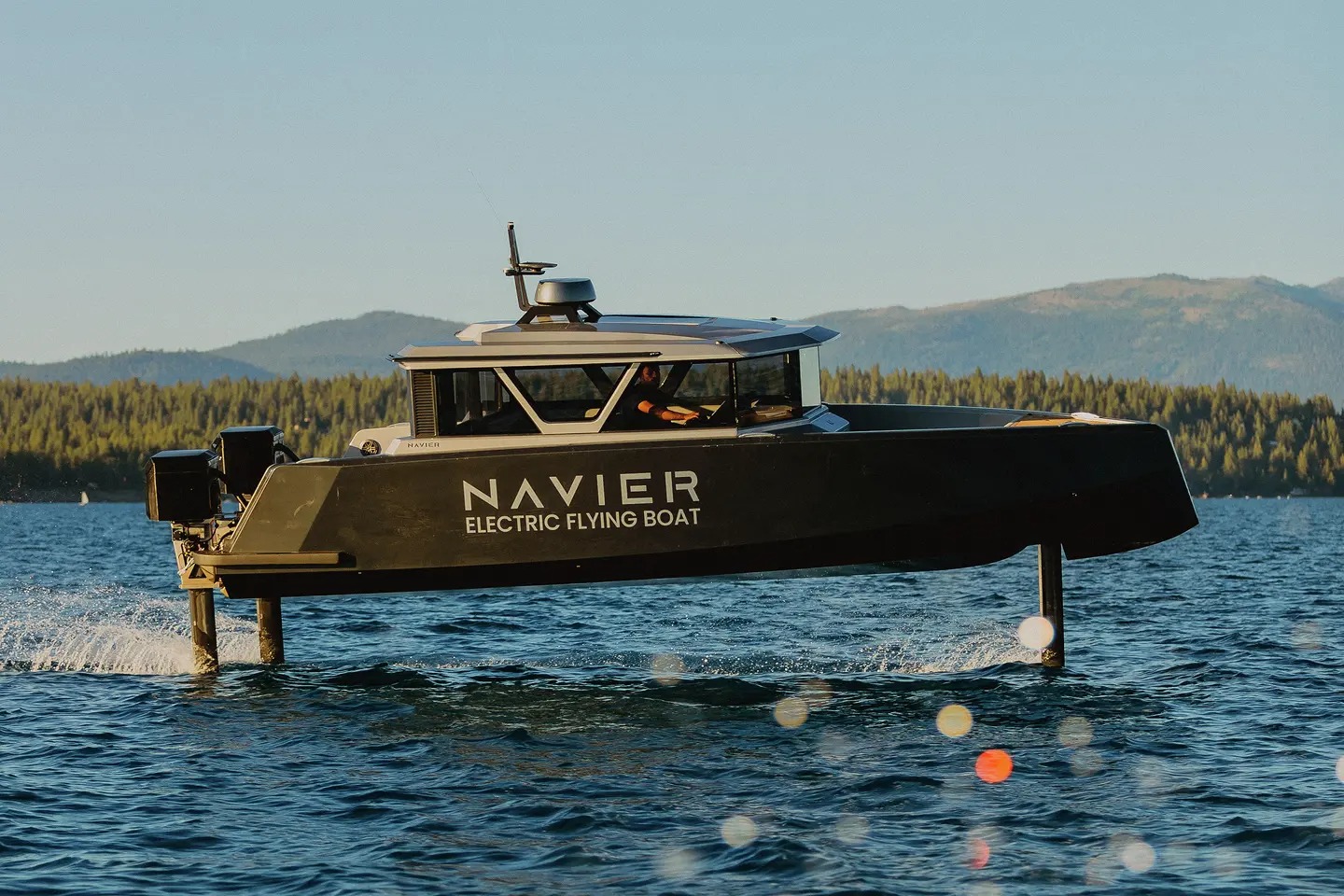
One second the hull grinds through chop; the next it lifts free of the water entirely, and the ride goes eerily quiet — like switching from a gravel road to glass. That transition is what Navier’s N30 delivers, and it’s hard not to be impressed. Then the price tag lands: $850,000. Which is roughly what a house costs in most American cities that aren’t already underwater, metaphorically speaking.
Navier CEO Sampriti Bhattacharyya argues that water travel in America is underused because of “costs, comfort and convenience.” Her solution is an Alameda-built electric hydrofoil yacht that looks like an Apple Store drifted out to sea — minimalist digital controls, no analog instruments, zero diesel smell. Hydrofoils are 150-year-old technology. Pairing them with electric motors and modern software is the actual bet Navier is making.
What the Ride Actually Feels Like
The hull lifts, the noise drops, and your skepticism wavers — at least briefly.
Leaving Alameda, the N30 reads like every premium EV you’ve ever driven: smooth, suspiciously quiet, engineered to make the future feel like it arrived ahead of schedule. The foiling transition does real work on choppy Bay water, smoothing out conditions that would leave a conventional hull pounding. Current owners reportedly include Tim Draper, and the boat is already deployed in Miami, Nantucket, and the Hamptons — luxury-first, by design, not accident.
- Boat: Navier N30, $850,000
- Tech: Electric hydrofoils lift the hull at speed, cutting drag and chop
- Interior: Digital controls only; no traditional analog instruments
- Markets: Miami, Nantucket, the Hamptons
- Investor signal: Tim Draper reportedly owns a vessel
From Yacht to Infrastructure Play
A $100 million Maldives deal is the proof-of-concept — but the charging infrastructure doesn’t exist yet.
Announced in June, Navier’s partnership with JIH Global Investment commits $100 million to deploy 100 N30s across the Maldives over three years. That’s the kind of network deployment that turns a luxury object into a platform. The charging infrastructure those boats require, however, doesn’t exist. Floating charging stations are being “explored.” Training for automated anchoring and foiling controls — neither familiar to most yacht operators — still needs building from scratch.
JIH chairman Mohamed Ali Janah expects the boats to arrive by early next year at the latest. That’s an ambitious timeline for a deployment that requires infrastructure no one has finished designing.
If this works, it becomes a legitimate proof of concept for cleaner island-hopping transport globally. If it stalls on a charging station, it’s an expensive fleet sitting in warm water.
The Honest Ledger
Brilliant hardware, real ambition, and infrastructure that exists mostly in press releases.
The N30 solves a genuine problem — diesel-heavy, rough, uncomfortable water travel — for people who can already solve most problems with a wire transfer. Whether Bhattacharyya’s path from the Hamptons to everyday harbor commuter holds up depends entirely on infrastructure nobody has built yet. The ride is real. The revolution is still on the waitlist.