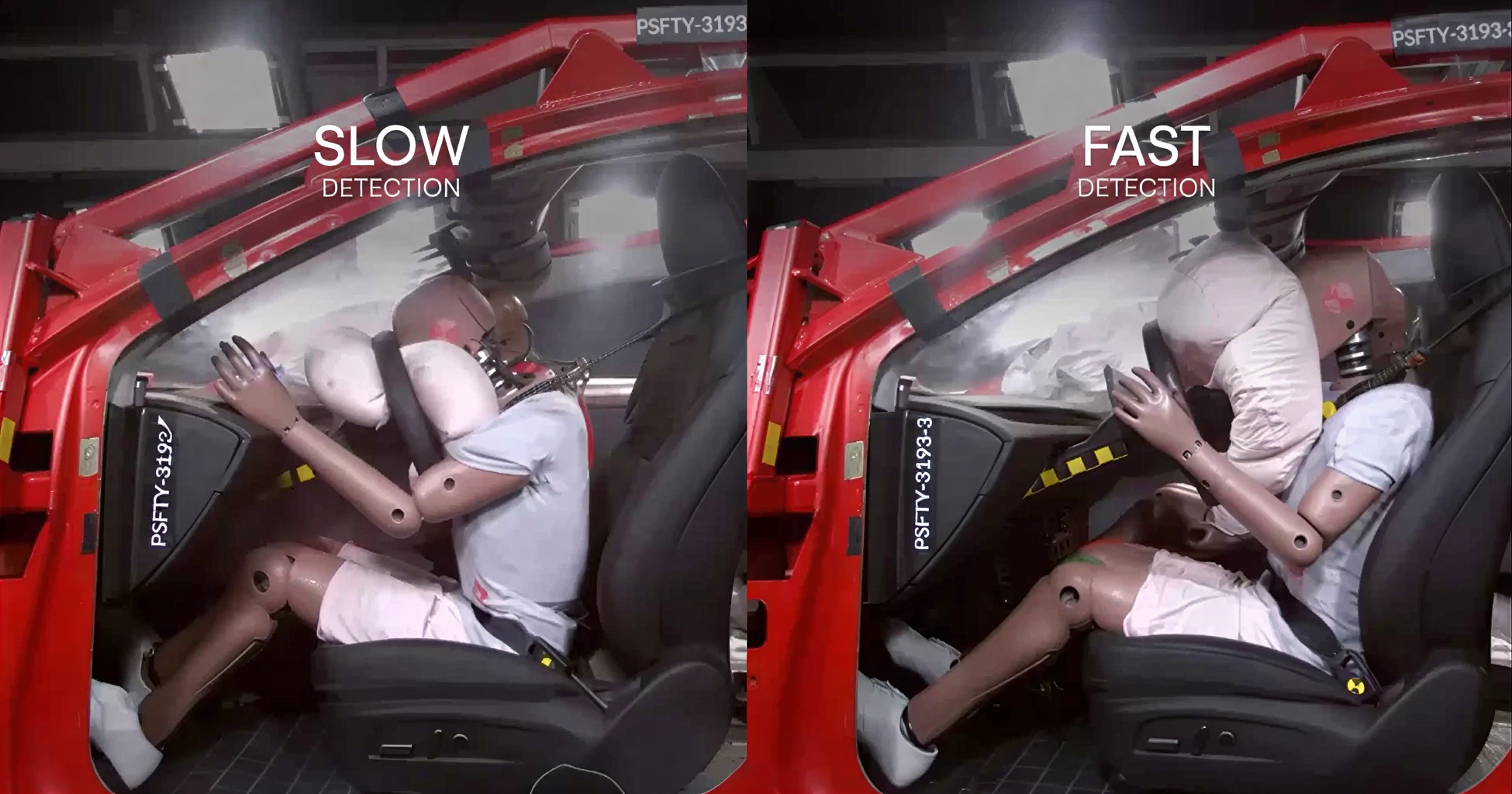
Your Tesla can now sense an unavoidable crash and deploy its airbags before impact. Tesla Vision, the company’s camera-based AI system, deploys airbags up to 70 milliseconds earlier than traditional cars that wait for physical contact to trigger sensors.
Traditional vehicles rely on accelerometers in bumpers that need actual impact confirmation before activating safety systems. Tesla’s approach flips this entirely—cameras and AI predict the collision, allowing seatbelt pretensioners to tighten and front airbags to begin inflating before your body even moves forward.
Real-World Fleet Data Beats Lab Testing
Tesla’s AI learns from millions of actual driving miles instead of sterile crash simulations.
Tesla Vision leverages driving data from millions of real-world miles rather than controlled crash test scenarios. While other manufacturers perfect their systems in sterile lab environments, Tesla’s AI learns from actual road conditions, weather variations, and the chaos of daily driving.
According to Tesla’s technical documentation, this predictive deployment “can be the difference between serious injury and walking away from a crash.” The system adds forward-looking confidence that traditional impact sensors simply can’t match.
Over-the-Air Update Brings Life-Saving Tech
September 2025’s software update delivered instant safety upgrades to existing Tesla owners.
The feature rolled out via software update 2025.32.3 in September 2025, reaching 2023 and newer Model 3 and Model Y vehicles, select 2022 models, and current Model S and X cars. All new Tesla include the capability, but it requires camera-based hardware rather than older radar systems.
This represents Tesla’s software-first philosophy in action. While competitors plan hardware revisions for their next model years, Tesla owners get cutting-edge safety improvements downloaded overnight.
Traditional Automakers Play Catch-Up
Legacy manufacturers still wait for actual impact before activating life-saving systems.
Legacy manufacturers still rely on physical sensors with built-in delays to prevent false deployments caused by potholes or minor impacts. These “filters” create hesitation that costs precious milliseconds during actual emergencies.
The difference between 70 milliseconds might sound trivial, but in high-speed crashes, those split seconds determine whether occupants experience controlled deceleration or violent impact. This advancement reinforces Tesla’s position at the intersection of automotive safety and artificial intelligence—turning every Tesla into a learning node that makes the entire fleet safer.