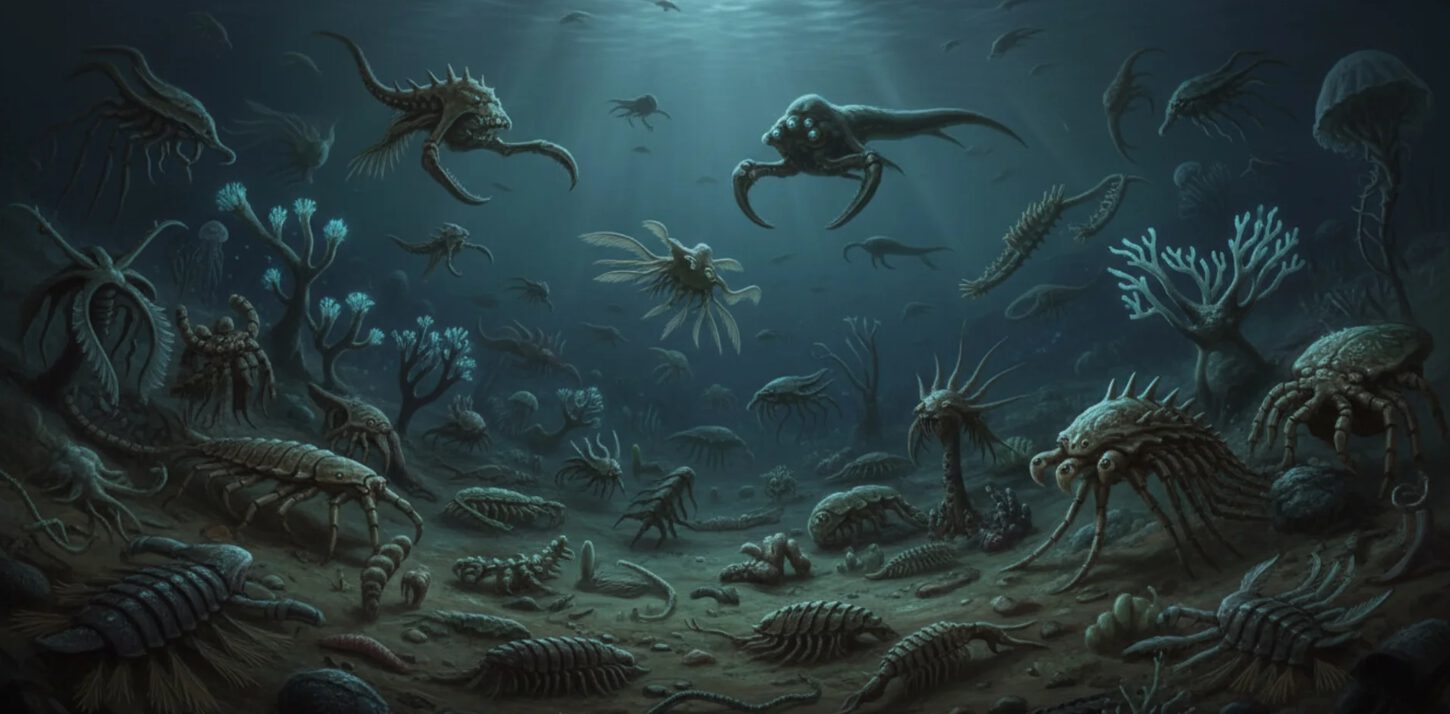
Scientists found a way to survive Earth’s ancient apocalypse—and the proof lies buried in a Chinese quarry. Paleontologists have unearthed over 50,000 fossils from Huayuan County, revealing 90 previously unknown species that thrived in deep ocean refuges after a mass extinction wiped out nearly half of all marine life 513 million years ago. You’re looking at evolution’s comeback story, preserved in exquisite detail.
Deep Ocean Sanctuaries Preserved Ancient Ecosystems
While shallow seas turned into graveyards, deep-water environments became Noah’s arks for marine life.
The Huayuan biota captures something remarkable: soft tissues, guts, even neural structures frozen in time through Burgess Shale-type preservation. These aren’t just fossilized shells and bones—you can see the internal anatomy of creatures that lived through one of Earth’s earliest extinction events.
The deep continental shelf setting acted like an environmental bunker, shielding complex ecosystems from the ocean deoxygenation that devastated shallow waters during the Sinsk event. Scientists from the Chinese Academy of Sciences analyzed 8,681 specimens spanning 16 major animal groups. The diversity rivals a modern coral reef, complete with apex predators called radiodonts wielding raptorial appendages like ancient mantis shrimp.
Bizarre Creatures Reveal Post-Apocalyptic Recovery
From cactus-like spinose animals to armored arthropods, evolution got creative after near-total collapse.
Picture a seafloor populated by organisms that look like they escaped from a sci-fi movie. The Huayuan fossils include:
- Spiky, cactus-shaped creatures called Allonnia
- Primitive sponges with preserved organic matter
- Entirely new arthropod species like fuxianhuiids
These weren’t evolutionary experiments—they were successful survival strategies.
“The Huayuan biota provides the first insights into the impact of the Sinsk event on deeper-water faunas,” according to senior author Maoyan Zhu from the Nanjing Institute of Geology and Palaeontology. The 153 identified species reveal a complex food web where animals occupied every available niche, from water column swimmers to seafloor scavengers.
Global Ocean Highways Connected Ancient Survivors
Shared species across continents prove that life’s recovery involved epic transoceanic journeys.
The most striking discovery? Many Huayuan species also appear in Canada’s famous Burgess Shale deposits, despite being separated by millions of years and thousands of miles. Species like Helmetia and Surusicaris arthropods somehow dispersed across ancient oceans, likely riding currents during sea-level fluctuations.
“The new fossils from China demonstrate that the Sinsk event affected shallow water forms most severely,” notes Michael Lee from South Australia’s Museum, highlighting how extinction’s impact varied by depth.
This global connectivity suggests that post-extinction recovery wasn’t isolated—it was a coordinated planetary phenomenon where deep-water refuges seeded the eventual recolonization of devastated shallow seas. The Huayuan discovery fills a critical gap between pre-extinction sites like Chengjiang and younger recovery ecosystems like Burgess Shale, published this January in Nature.
Ancient mass extinctions offer sobering lessons for modern biodiversity loss. Deep oceans might again serve as humanity’s last biological insurance policy.