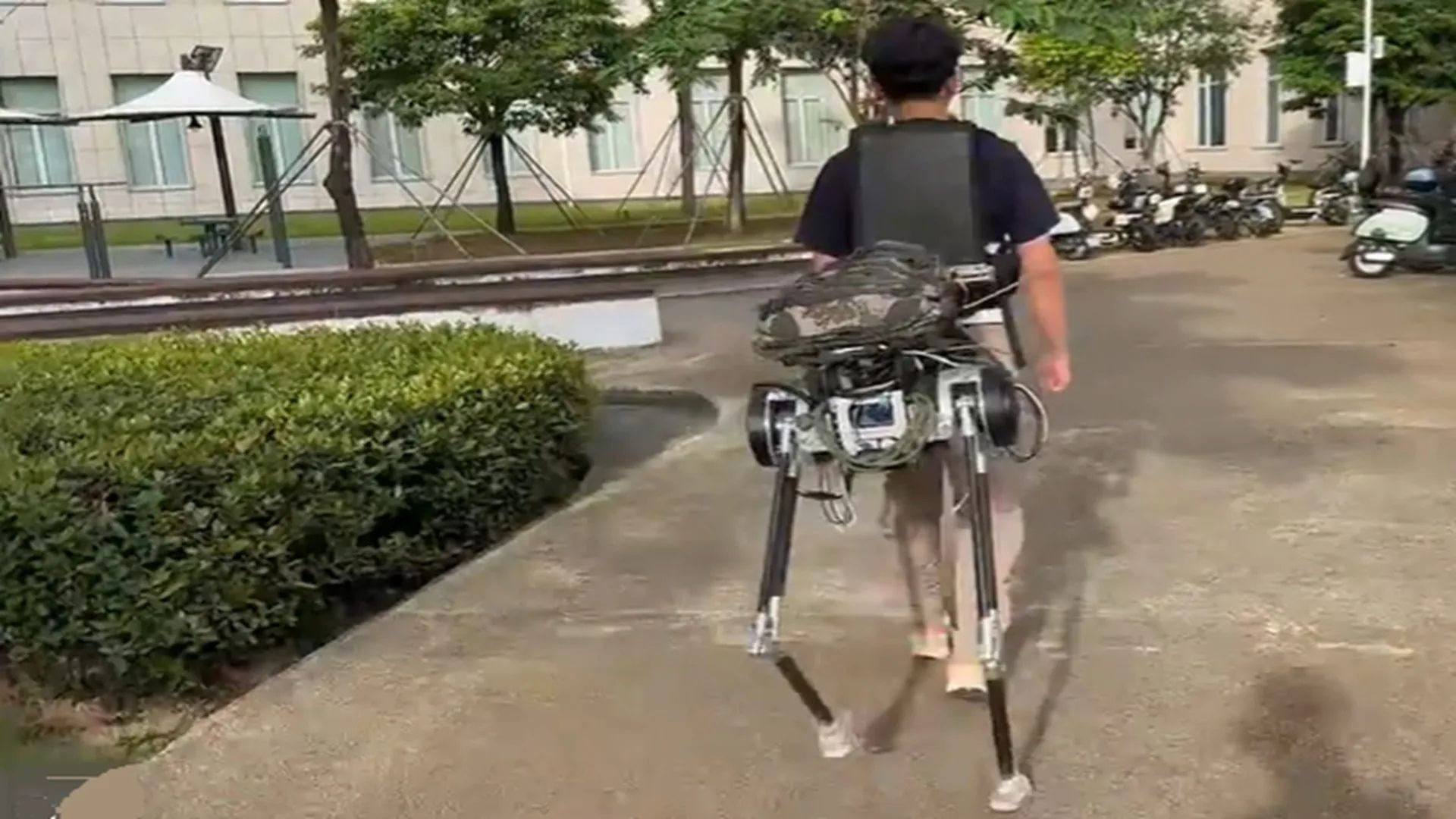
Hauling a 44-pound backpack normally turns your legs into jelly and your feet into hamburger, but researchers at Southern University of Science and Technology just cracked that problem. Their centaur-style robot slashes walking effort by 35% and cuts foot pressure in half—not through magical thinking, but by literally giving you two extra mechanical legs.
How This Robot Centaur Actually Works
Unlike those clunky exoskeletons strapped to your limbs, this system operates like having a tireless pack mule attached to your back. The two robot legs handle the heavy lifting and propulsion while you focus on steering and balance—think of it like GPS handling navigation while you concentrate on driving.
The genius lies in its elastic coupling system that stiffens under light loads to keep everything coordinated, then softens when things get heavy to absorb the brutal forces that would otherwise pound your joints.
Model predictive control algorithms sync the robot’s gait with yours, maintaining natural walking patterns even when you’re hauling serious weight. Testing with 20-kilogram loads showed participants maintained their normal stride while the mechanical legs shouldered over half the burden.
Real-World Applications Beyond the Lab
- Military logistics teams could trek longer distances carrying essential supplies without the usual physical breakdown
- Disaster response crews navigating rubble with heavy rescue equipment would benefit from the enhanced stability and reduced fatigue
- Industrial workers hauling tools across rough terrain could extend their operational range significantly
The SUSTech research team published their findings in The International Journal of Robotics Research, lending academic credibility to what sounds like science fiction. However, this remains a prototype—you won’t find these robot legs on Amazon anytime soon.
The Future of Human Augmentation
This centaur approach represents a fundamental shift in how we think about human-robot collaboration. Rather than replacing human capabilities or awkwardly duplicating them, it creates a hybrid system where each partner handles what they do best. Your brain navigates while mechanical precision handles the grunt work—a partnership that could redefine physical labor entirely.