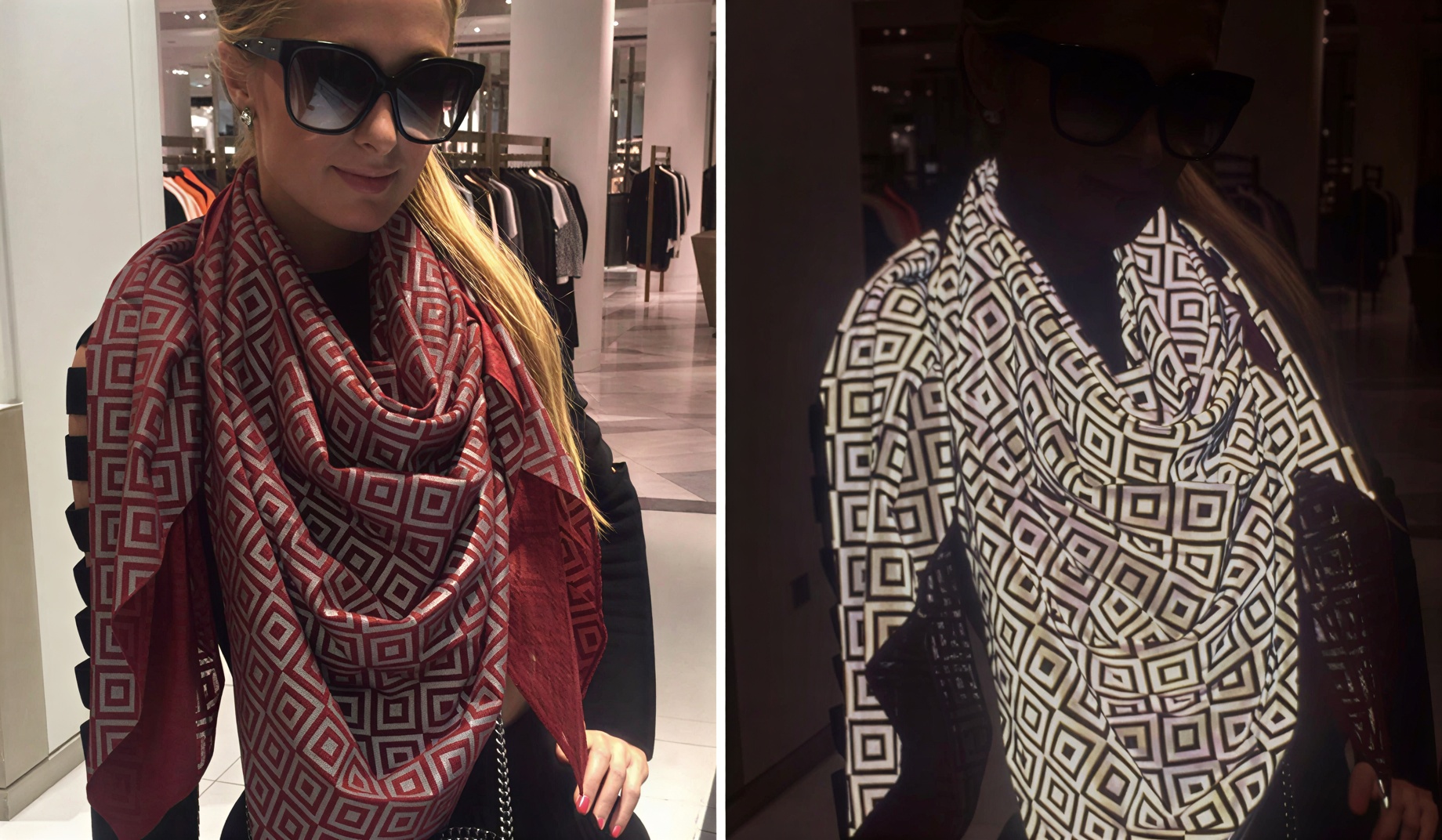
Flash photography stalks celebrities everywhere, but the ISHU scarf flips the script entirely. London designer Saif Siddiqui embedded thousands of nano-spherical crystals into fabric that retro-reflects light directly back into camera lenses. When paparazzi fire their flashes, the scarf lights up like a beacon while the wearer’s face disappears into blackness.
Your typical auto-flash camera gets completely fooled—its pre-flash metering reads all that reflected light and massively underexposes the actual shot.
Celebrity Endorsement Meets TikTok Virality
Paris Hilton’s recent social media buzz revived interest in this nearly decade-old privacy gadget.
The ISHU scarf first gained traction around 2016, but Paris Hilton’s recent TikTok appearances wearing one sparked fresh curiosity about anti-paparazzi fashion. She joins an impressive roster including Beyoncé, Jay-Z, Cameron Diaz, and Kevin Hart—all betting $268 to $478 on fabric-based photo protection.
The geometric patterns actually look stylish, which matters when you’re turning privacy paranoia into a fashion statement. These aren’t tinfoil hat territories; they’re legitimate luxury accessories for people whose images have monetary value.
Reality Check on Photo-Blocking Claims
Manual flash settings and natural light photography easily bypass this expensive trick.
Here’s where the magic breaks down: photographers who know about ISHU can simply switch to manual flash or skip flash entirely. Natural light portraits work fine, and adjusted camera angles can minimize the reflective effect.
You’re essentially paying premium prices to thwart lazy paparazzi using automatic camera settings. The scarf works brilliantly in its specific use case but won’t stop determined photographers with basic technical knowledge.
Privacy Fashion’s Expensive Learning Curve
Anti-surveillance clothing reveals our complex relationship with unwanted photography.
The ISHU phenomenon exposes something deeper than celebrity vanity—it’s fashion responding to our surveillance anxiety. Whether you’re dodging paparazzi or just don’t want strangers snapping photos at restaurants, the desire for photo control feels increasingly relevant.
The technology works, the price stings, and the availability remains murky ten years after launch. But the concept survives because the problem persists: cameras everywhere, consent nowhere, and people willing to pay for the illusion of invisibility.