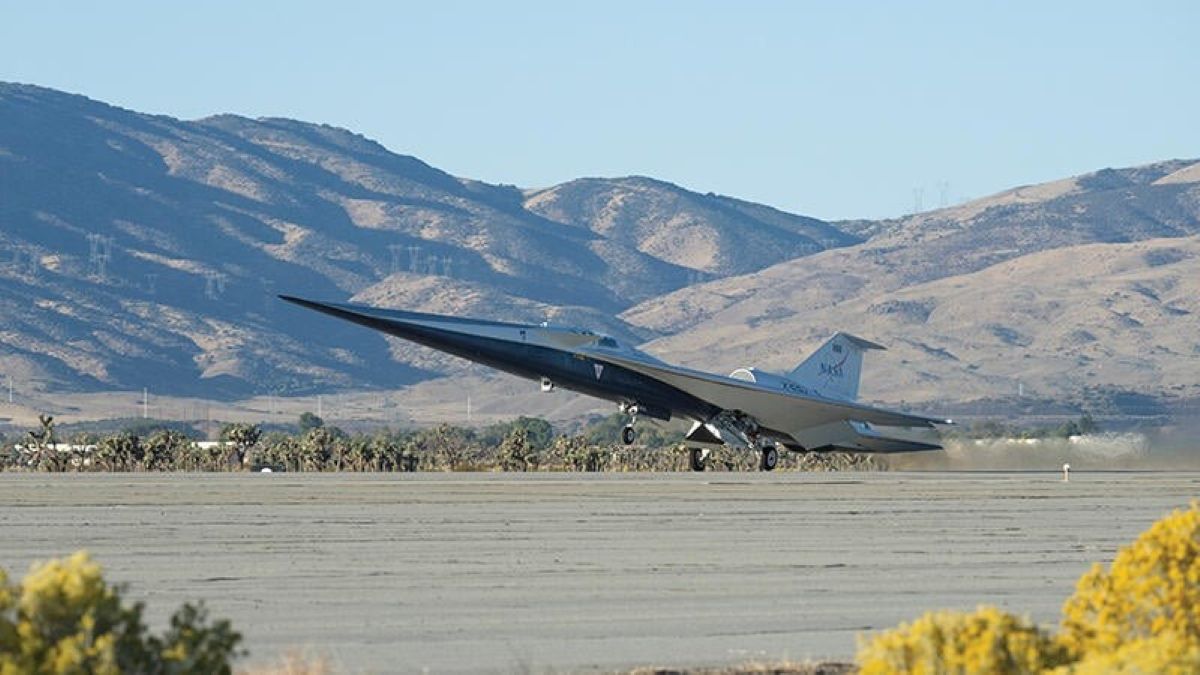
The 1973 FAA ban restricted supersonic flight over U.S. land, but NASA’s X-59 just proved the solution actually works. The experimental aircraft completed its inaugural flight on October 28, 2025, validating technology that reduces sonic booms from Concorde’s ear-splitting 105 decibels down to 75 decibels—roughly the difference between thunder and a car door slamming down the street.
Test pilot Nils Larson flew the unconventional aircraft from Palmdale to Edwards Air Force Base, conducting basic handling checks that confirmed fifteen years of computational modeling. “It flies a lot like the simulator,” Larson reported, “so that’s a good thing, because if you’ve guessed your aerodynamic model pretty well, then hopefully the flight control designers have also guessed well.”
The X-59’s bizarre appearance isn’t accidental—it’s engineered to break up shock waves before they reach the ground. That 38-foot nose stretches so long that pilots can’t see forward, requiring a camera system for takeoffs and landings. The engine sits above the wing, directing shock waves upward instead of earthward. Think of it as acoustic origami, folding sound waves away from populated areas.
Three-Phase Testing Will Determine Aviation’s Future
Ground sensors and community feedback will provide data for overturning the supersonic flight restrictions.
The real work starts now. Phase one involves pushing the aircraft to Mach 1.5 and 60,000 feet throughout 2026, expanding its flight envelope like a cautious teenager learning to drive. Phase two deploys 125 autonomous recording stations along a 30-mile line to capture the aircraft’s acoustic signature with scientific precision.
Phase three gets interesting—flying over actual communities to measure public response. Your reaction to that distant thump could help rewrite aviation regulations that have restricted overland supersonic flight since Nixon was president.
“I’d say we are finally at the starting line,” explains mission integration manager Peter Coen. “It’s been a long road, about 15 years, from ‘Hey, we think we can do this’ to flying for the first time.”
Commercial Supersonic Travel Could Return by 2035
Success could slash cross-country flight times in half while meeting noise regulations.
The payoff timeline stretches longer than a Marvel movie franchise, but the implications are transformative. If community testing shows acceptable noise levels, the FAA and international aviation authorities could establish new supersonic flight standards by 2030. Commercial aircraft following the X-59’s low-boom principles could enter service in the mid-to-late 2030s.
Your three-hour coast-to-coast flight suddenly becomes possible again—without the regulatory restrictions that limited Concorde to transoceanic routes. The X-59 isn’t just proving that quiet supersonic flight works; it’s potentially unlocking an entire aviation market that’s been frozen since the Carter administration.