Most pool robots spend as much time on your deck as they do in the water. They clean for an hour or two, come out to charge for a few hours, and go back in. Meanwhile, the pool keeps getting dirty. Leaves pile up. Algae gets a head start. You come home to water that looks nothing like what the robot left behind, and the whole process starts over.

Someone has to retrieve the robot, carry it to the charger, remember to put it back in, and keep track of when it last ran. That someone is you. Every time. All summer.
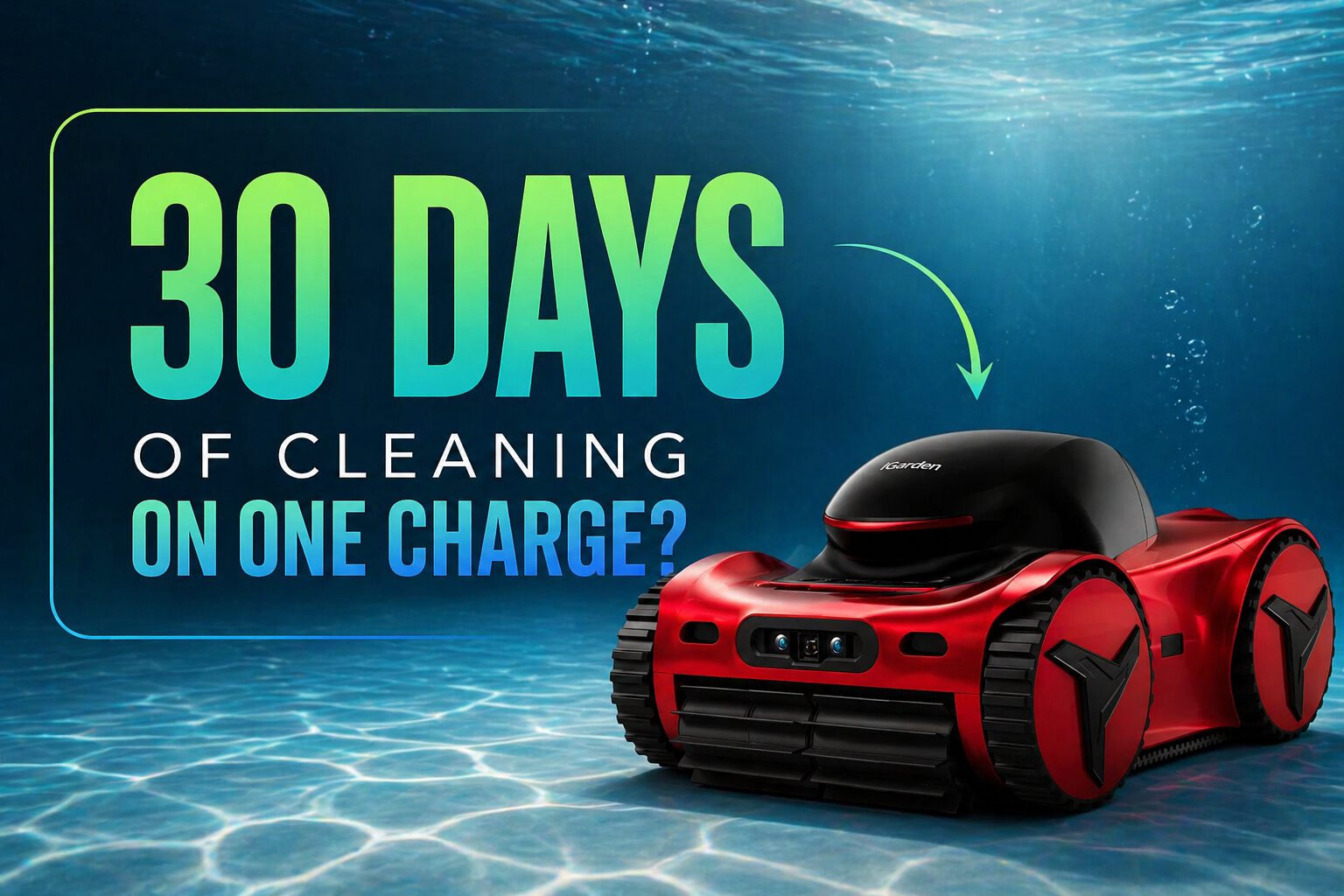
The iGarden Pool Cleaner M1 AI Series was built around a different idea entirely. It stays submerged, runs on a schedule you set once, and handles the pool without you in the loop at all. Thirty days. No retrieving, no recharging, no checking on it. You set it, and the pool stays clean.
If your pool season looks anything like the one we just described, the M1 AI Series is worth a look.
30 Days. In the Pool. On Its Own.
Most pool robots will finish cleaning a pool within 90 to 180 minutes, which means someone has to retrieve them, charge them, and get them back in before they’re useful again. The M1 skips that entire sequence.
Using intelligent underwater wake-and-sleep cycles and a high-efficiency battery, it stays submerged and runs on a schedule you set once, waking up when it’s supposed to, cleaning, and going back to standby without you touching it. That window stretches to 30 days before it needs to come out.
If you’ve ever come home to a pool that needed cleaning because you forgot to run the robot, or because it ran out of charge mid-cycle and sat there doing nothing while leaves piled up, you already understand what this solves. Your pool stays clean on a schedule, and the schedule runs itself.
It Sees Your Pool. Other Robots Don’t.
The way most pool robots navigate hasn’t really changed in years. They run a pattern, cover the floor in rows, and hope the debris happens to be somewhere along the route. When it isn’t, they keep going anyway, covering clean tile and missing the corner that actually needs attention. You find out when you get in the water.
The M1 uses iGarden’s Bionic AI Dual-Camera Vision system, which gives it real-time 3D awareness of what’s actually in the pool. It identifies debris, maps the layout, and adjusts its path based on what it sees rather than a pre-programmed grid.
When it detects an area that needs another pass, it goes back. When it encounters an obstacle, it routes around it. It reads the pool the same way on a cloudy afternoon as it does in full sun, adjusting to surface type and lighting conditions as they change. The dual-camera setup is what makes that level of precision possible, and no other pool robot on the market is built around it. You can see exactly how it works and order directly through iGarden’s website.
20 Minutes to a Clean Pool
Because the M1 targets high-debris areas first rather than methodically covering every square foot in sequence, it reaches near-complete pool coverage in as little as 20 minutes. Most robotic cleaners take several times that, which is fine when you’re planning ahead, and a real problem when you need the pool ready in an hour.
A 20-minute cycle means you can decide the pool needs cleaning and have it done before the situation demands it, rather than running the robot the night before and hoping for the best. Paired with the M1’s autonomous scheduling, the pool is simply ready when you want it, without you having to keep track of when it last ran.
It Uses a Tenth of the Energy
Running a pool robot more often is the obvious answer to keeping a pool consistently clean, and it’s also the answer most people talk themselves out of because of what it adds to the electricity bill. The M1 runs on iGarden’s AI Inverter 2.0 architecture, which reads the cleaning task in real time and adjusts power output to match what’s actually needed rather than running at full draw through the entire cycle. The result is full cleaning performance at as little as one-tenth the energy of a conventional system.
That changes the math on running it more frequently. A robot that operates at a fraction of the energy cost of a standard cleaner, on an automated schedule, cleans your pool more often for less money per cycle than the robot you’re currently retrieving and recharging by hand. The full specs, including the energy consumption breakdown, are on iGarden’s website.
Built to Handle the Heavy Work
The M1 pairs its vision system with InfinityDrive for sustained runtime, HyperBoost for high-intensity suction when the debris load demands it, and a dual-layer filtration design that keeps performance consistent even when the basket is working hard. These are the components that make 30-day autonomous operation possible without the cleaning quality degrading halfway through the month.
The obstacle recognition and automatic re-cleaning work together so that corners, edges, and high-debris zones get the same attention as the open floor. The pool that comes out of a cycle is completely clean, rather than mostly clean with a few spots the pattern missed, and that consistency is what actually justifies leaving a robot in the water for 30 days rather than just claiming it’s possible.
What This Actually Changes
Pool ownership has always involved a quiet negotiation between how clean you want the water and how much time and attention you’re prepared to spend getting it there. The M1 removes that negotiation. You set a schedule, the robot handles the pool, and maintenance stops being something you manage and starts being something that happens without you.
Nothing else on the market puts together autonomous 30-day in-pool operation, dual-camera AI vision, 20-minute cleaning cycles, and one-tenth the energy consumption of a conventional system. That combination is what makes the M1 less of an upgrade decision and more of a first-time purchase in a category that didn’t exist before it. If that sounds like what your pool season has been missing, iGarden’s website is where to start.