Three Chinese organizations completed a 1,007.48-kilometer hollow-core fiber transmission test, claiming the world’s first bidirectional real-time verification at this scale. The result is a meaningful milestone for a technology that has, until now, proven itself mostly over short experimental links, not unlike how researchers recently broke the internet speed barrier using optical display technology. Bidirectional operation at backbone-network distances changes the conversation about where hollow-core fiber can realistically go next.
What They Built and How It Performed
The consortium carried 64 Tbps in each direction simultaneously, with a reported one-way latency of approximately 3.43 milliseconds across the full route.
China Telecom Research Institute, Yangtze Optical Fibre and Cable (YOFC), and ZTE conducted the test, according to reported results. The system delivered 800 gigabits per second per wavelength using PCS-16QAM modulation across the extended C+L band.
The trial maintained at least 3 dB of loss margin per span and at least 3 dB of optical signal-to-noise-ratio margin, according to the consortium’s reported results. Both figures represent reported operating margins intended to support real-world maintenance headroom.
The test also demonstrated extended C+L-band transmission without a gain equalizer, which may reduce hardware requirements in this demonstrated configuration.
Why Hollow-Core Fiber Is Different
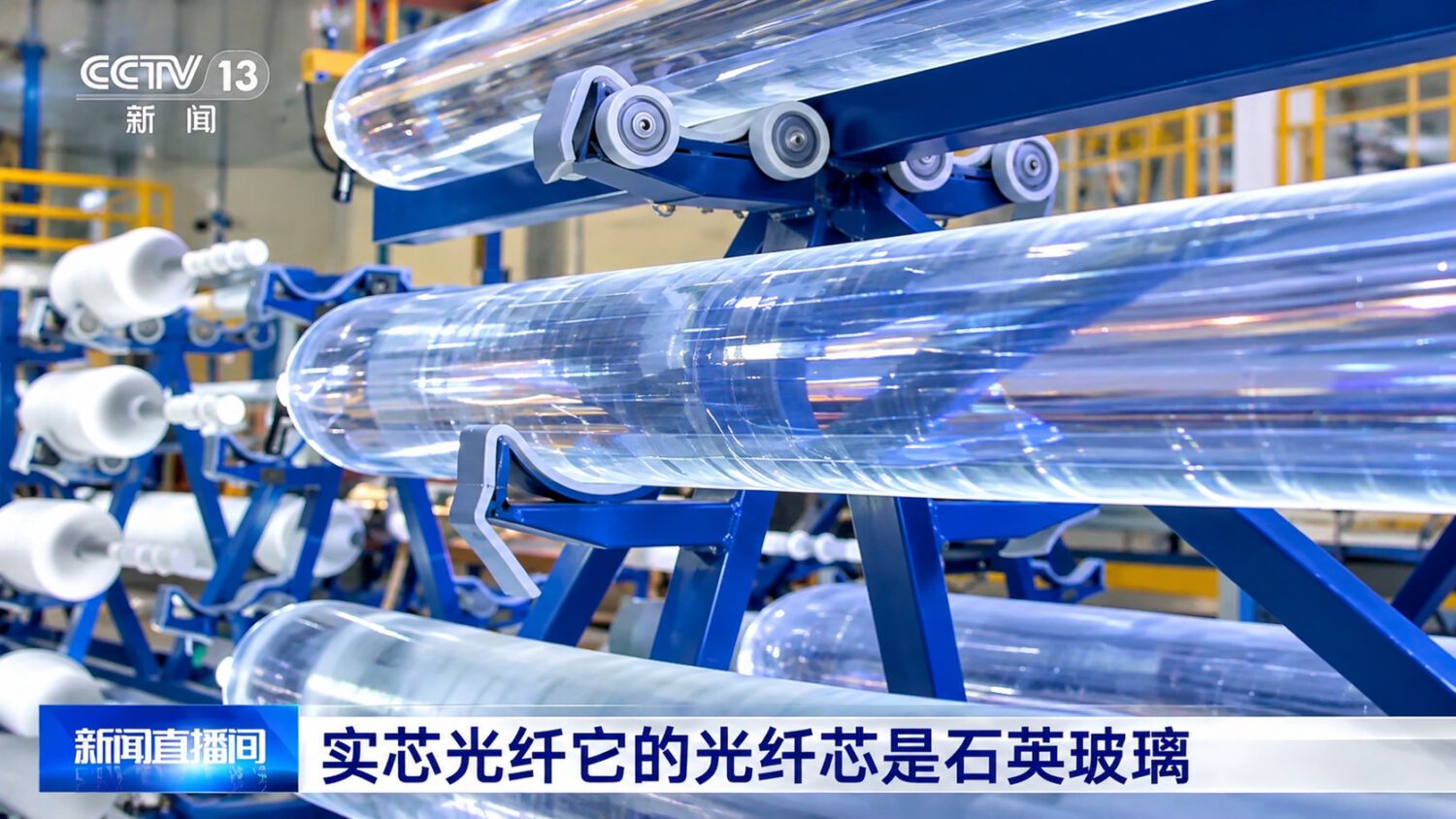
Hollow-core fiber routes signals through an air-filled core rather than solid glass, which reduces propagation latency and can open up potentially wider usable bandwidth depending on the full optical system.
In conventional fiber, light slows as it passes through glass. Air is closer to a vacuum, so signals travel faster and arrive sooner.
That physics difference is what makes the reported 3.43-millisecond figure notable. Crossing 1,000 kilometers in roughly the time it takes to blink reflects a contribution from the medium itself, not only from the electronics.
Where This Could Actually Land
Backbone networks, data-center interconnection, distributed AI infrastructure, and financial links are among the most plausible early targets for hollow-core deployment.
These are environments where reducing latency by milliseconds can carry measurable economic value. That applies to algorithmic trading and to coordinating distributed AI training jobs across geographically separated data centers, though the precise benefit depends on workload architecture and total system design.
Hollow-core fiber is not positioned to replace conventional glass fiber in ordinary access or metro networks. Early adoption is more likely to concentrate on specialized, high-value routes where the latency case is strong enough to justify the added complexity and cost premium.
What Still Has to Work
Manufacturing, splicing, bending reliability, equipment compatibility, and cost remain significant challenges at the scale real deployments require.
A transmission verification over a controlled test route is a proof of concept. It is not evidence that hollow-core fiber is ready for field crews, diverse routes, or long-term operation.
Connectors and splices that hold up in a lab do not automatically hold up in a conduit or underwater. A repair crew working in the field introduces an entirely different set of demands.
Getting from this result to deployed infrastructure requires manufacturing scale, equipment standards, and extended field trials. The numbers reported here are strong enough to take seriously. They are not strong enough to treat as a finished product.