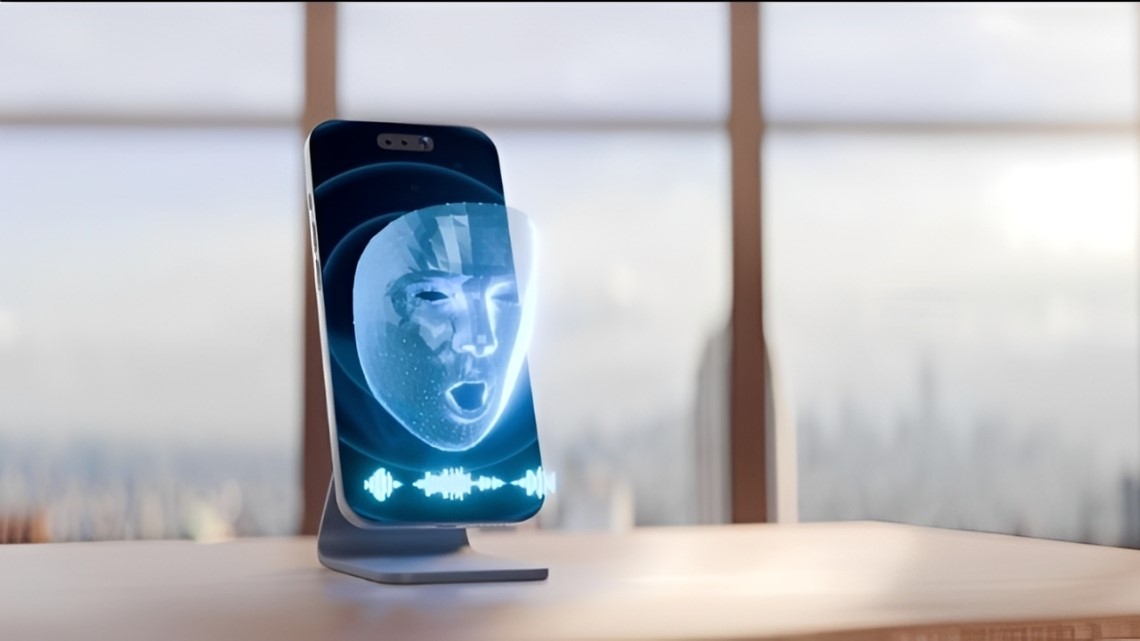
Your next iPhone could supposedly project holograms that respond to tilting and eye movement, according to supply chain whispers. Leaker “Schrödinger” claims Apple is developing a “Spatial iPhone” codenamed “MH1” or “H1,” featuring Samsung’s holographic AMOLED panels with eye-tracking and diffractive beam-steering technology. The rumored display would deliver glasses-free 3D depth effects while maintaining full 4K resolution in 2D mode—addressing past failures like Nintendo’s blurry 3DS screens.
These claims remain entirely unverified, originating from social media posts without official confirmation. However, the technical specifications align with Samsung’s documented holographic research capabilities.
Reality Check Reveals a Distant Timeline
Phase 1 R&D status suggests 2030 launch, making current iOS features more relevant.
Physics and engineering timelines tell a different story than breathless rumors. This alleged project remains in early R&D phases with a theoretical 2030 target—roughly four iPhone generations away, assuming Samsung’s holographic research translates to pocket-sized devices without melting your hand.
Meanwhile, iOS 26 already delivers “Spatial Scenes” that add 3D parallax to any photo on iPhone 12 and newer models. This proven feature offers an immediate taste of spatial computing that works with your existing hardware, transforming regular photos into lock screen wallpapers with subtle depth effects.
The Source Has Mixed Credibility
Schrödinger accurately predicted Galaxy specs, but lacks a verified Apple track record.
Credit where it’s due: Schrödinger correctly predicted Galaxy S26 Plus specifications months before Samsung’s February launch, nailing the Exynos 2600 processor and 12GB RAM configuration. That track record suggests legitimate supply chain connections—at least for Samsung devices.
Apple leaks demand different verification standards, though. Samsung’s Advanced Institute of Technology does conduct legitimate holographic research, with published work demonstrating 4K holographic video in 1cm-thick panels. Whether that translates to iPhone-ready technology represents a massive engineering leap.
Apple’s Spatial Strategy Suggests Genuine Interest
Vision Pro integration and decades of patents support holographic display development.
Apple’s spatial computing push extends beyond Vision Pro into mainstream devices, creating a foundation for advanced display technology. Patents dating to 2008 cover glasses-free autostereoscopic displays, while 2014 filings address touchscreen holography using micro-lenses. SVP John Ternus recently described spatial computing as an “inevitable” evolution still in “early innings.”
That language suggests Apple views holographic displays as destination technology, even if the journey takes another decade. Combined with iOS 26’s Spatial Scenes and Vision Pro’s spatial interface, the company appears committed to this direction.
These rumors feel more like wishful projection than imminent reality. Your iPhone upgrade decisions should focus on proven features—better cameras, faster chips, longer battery life—rather than holographic possibilities that may never materialize. But if Samsung’s research proves viable and Apple’s patience pays off, the 2030s could transform how you interact with digital content on devices that fit in your pocket.