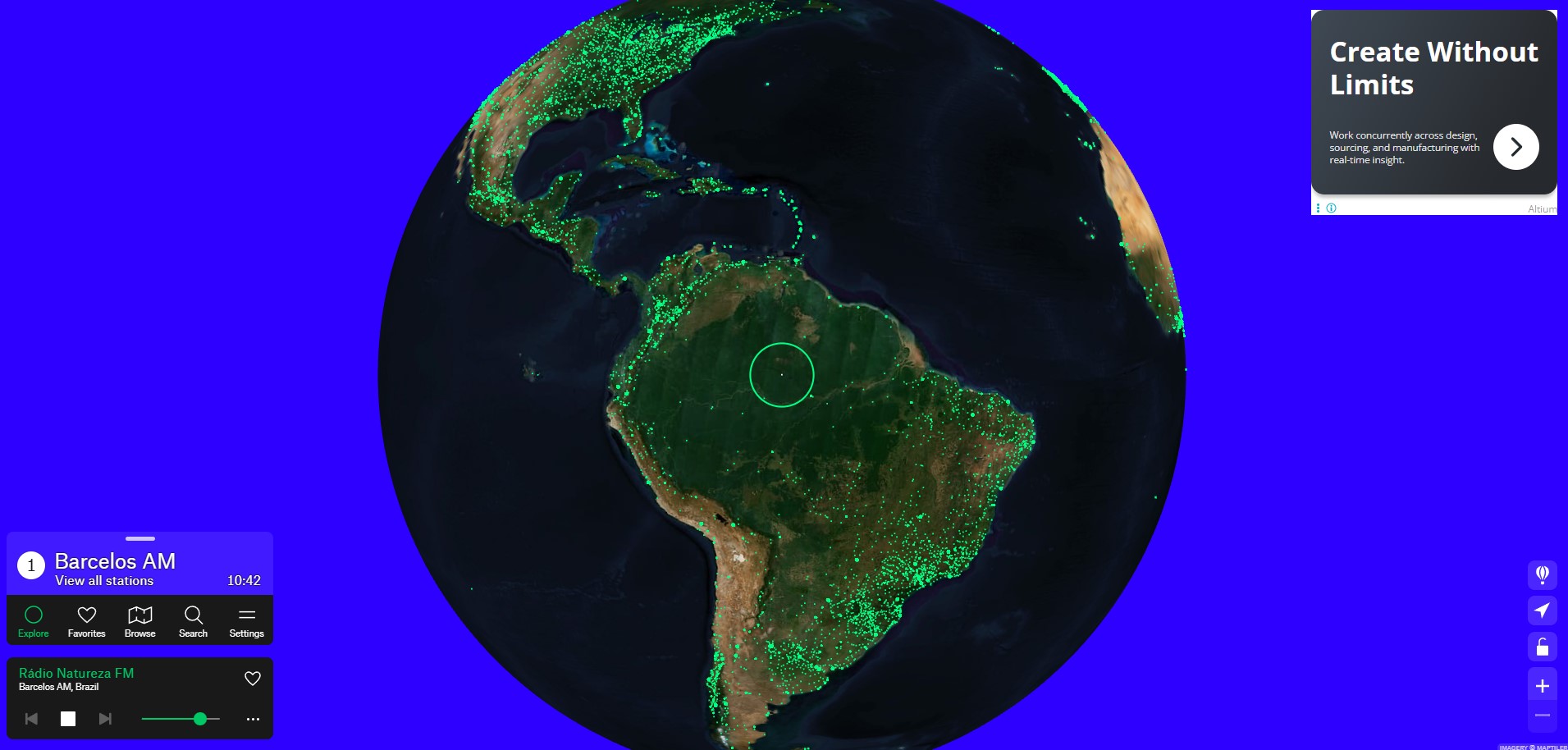
For anyone exhausted by algorithmic playlists recycling the same chill rotation week after week, Radio Garden exists as a deliberate counterpoint. Amsterdam-based designer Jonathan Puckey built a 3D spinning globe — powered by CesiumJS, a WebGL mapping library that renders smooth rotation right in your browser — where every green dot represents a live radio station. Tap one, and you’re instantly hearing whatever is broadcasting from that city right now. No account. No genre menus. No algorithmic carousel.
The platform doesn’t host audio; it aggregates public streams and indexes them by GPS coordinates. Where TuneIn gives you a searchable list, Radio Garden gives you a planet.
What You Need to Know
The basics, without the press release polish.
- Launched December 2016 with roughly 8,000 stations; now indexes tens of thousands worldwide
- Free on the web at radio.garden — no sign-up required; iOS and Android apps also available
- Mobile apps are freemium: interface ads appear unless you pay for Premium ($2.99/month or $24.99/year), which removes ads and adds favorites and sleep timers
- Some geographic gaps exist — parts of China are underrepresented due to incompatible streaming formats
- Built by Studio Puckey for the Netherlands Institute for Sound and Vision — not by India’s ISRO, despite viral claims that AFP fact-checked and debunked
A Lockdown Lifeline That Stuck Around
Millions of users discovered it while stuck at home — and kept coming back.
During COVID lockdowns, usage surged as diaspora communities tuned into hometown stations from thousands of miles away, according to The Guardian. Heavy traffic poured in from India, Mexico, Brazil, the US, and Gulf states. Think of it as shortwave radio scanning rebuilt with a Google Earth interface — nostalgic for anyone who remembers twisting a dial, novel for anyone who hasn’t. Spinning the globe and landing on a distant city feels less like using an app and more like eavesdropping on a real community, not a playlist curated around your data profile.
What It Won’t Do – And Why That Matters
No skip button. No replay. No playlist export. That’s the whole point.
Landing mid-commercial break in Nairobi means waiting it out, just like everyone else in Nairobi. There’s no saving tracks or building playlists. The difference between Radio Garden and Spotify is the difference between watching live sports and scrolling a highlight reel — one has stakes, the other is edited for your comfort. Radio Garden surfaces what human broadcasters chose to air, not what a data science team predicted you’d click.
Open radio.garden tonight. Spin the globe once. Whatever you land on will almost certainly be more surprising than anything your algorithm has served lately — and that’s entirely the point. Diaspora listeners, curious travelers, and anyone craving unmediated discovery will find it hard to stop at just one city.