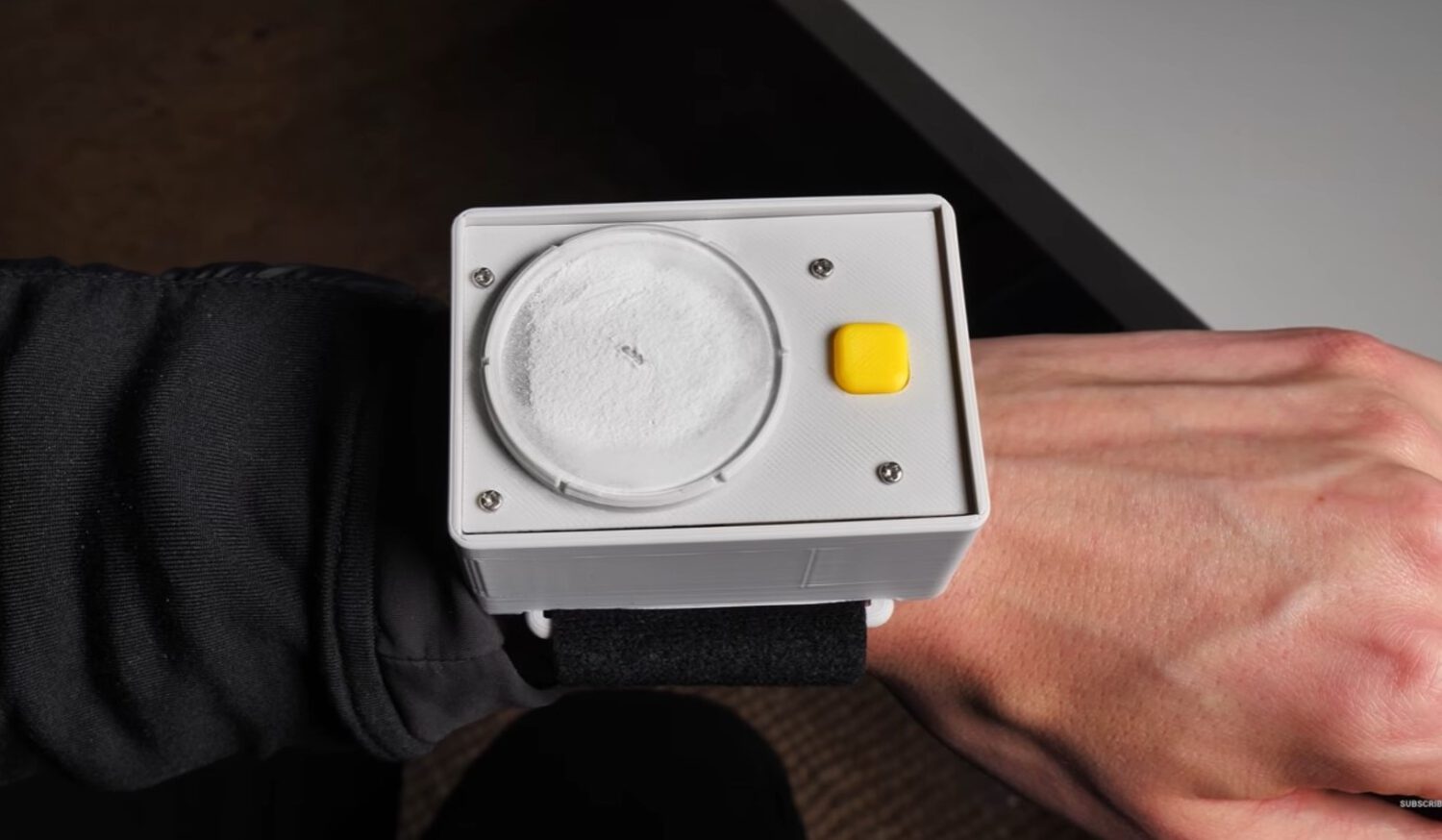
Instead of hands or a digital display, this wristwatch draws the current time as lines in a fine powder, then redraws them when the minute changes. The project comes from Jens, a Netherlands-based maker working under the name Strange Inventions, and has been covered by The Verge and TechEBlog.
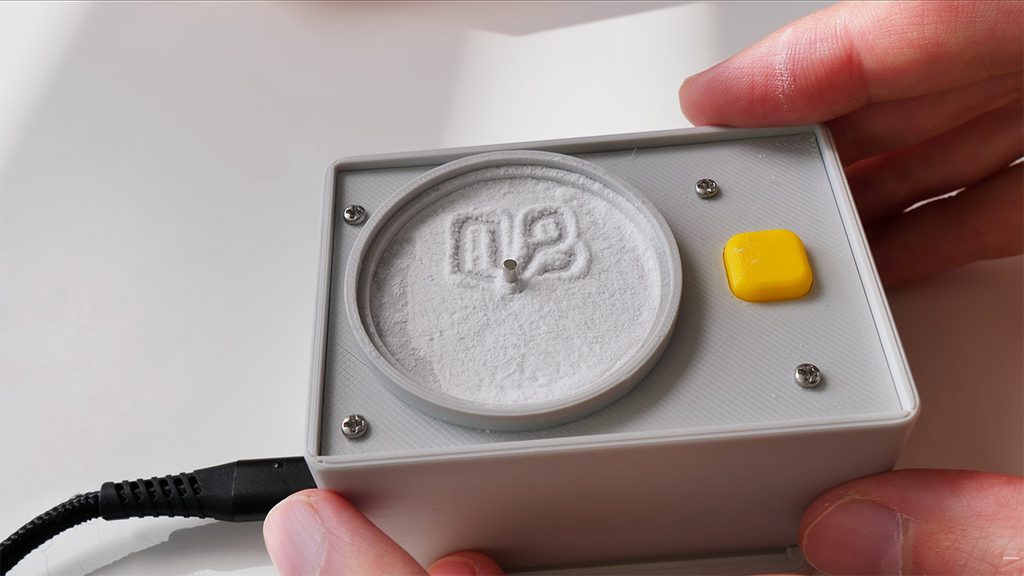
A small cylindrical magnet sits beneath the watch face and is moved by an actuator beneath the surface. A basic microcontroller calculates the required numeral paths and directs the actuator, moving the powder across the face to form digits.
The drawing process takes several seconds each time the minute changes. Once the numerals are formed, the mechanism returns to a resting position, and the lines remain visible until the next update or a separate reset movement clears them.
Sand Was the First Problem
Getting powder to behave at wrist scale required abandoning ordinary sand entirely.
Ordinary sand proved too coarse for this application, leaving visible gaps in the drawn strokes and breaking up the numerals. Finer particles created a different problem, clumping together and adhering to the transparent cover that encloses the face.
The reported solution, according to TechEBlog, was a carefully sifted mixture of fine iron dust and non-magnetic filler. That combination allows the magnet to move material into readable lines without the particles sticking permanently to the cover or to each other.
Shrinking the Concept Creates Its Own Problems
What works on a tabletop sand-drawing machine becomes considerably harder to engineer at wrist scale.
Larger sand-drawing tables use the same magnetic principle with considerably more room to work. At tabletop scale, the mechanism has space for a more responsive actuator and room to produce numerals that are easier to read.
At wrist scale, both factors are more difficult to manage. The reduced face area makes producing clean, legible digits a harder engineering problem, and controlling the magnet’s influence over the powder precisely becomes more demanding, as TechEBlog’s coverage describes.
This Is Not a Watch You Glance at Quickly
The update speed and display legibility make this unsuitable as a daily timepiece replacement.
The several-second redraw time and the soft edges that powder lines naturally produce make quick readability a challenge, as noted by The Verge. By conventional timekeeping standards, those are significant limitations.
The design appears to prioritize spectacle over precision. Its value is the experience of watching time get written out as a temporary physical act, minute by minute, rather than read off a persistent display.
The Display as Performance
Strange Inventions reframes timekeeping as a repeating material process rather than a continuous readout.
Most displays, from analog hands to LCD panels, treat the current time as something to be shown continuously and immediately. This watch treats it as something to be produced and then allowed to disappear.
What the project surfaces is a quieter question about what any display is actually required to do: persist indefinitely, or simply appear long enough to be useful before the next moment rewrites it.