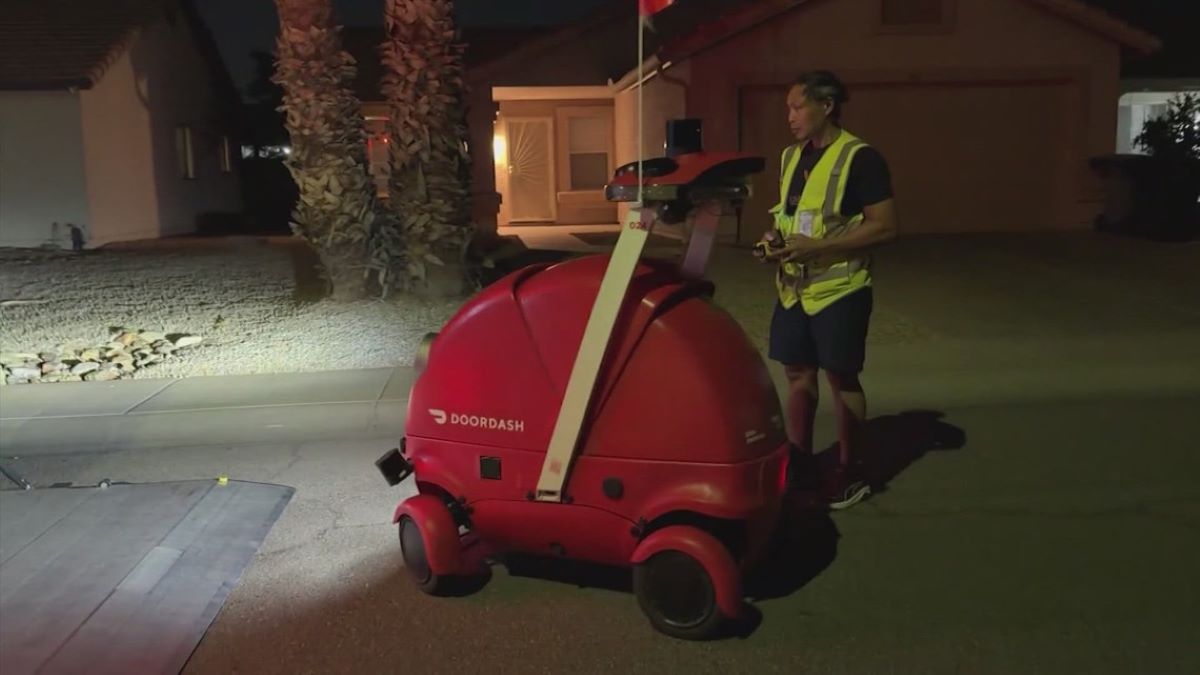
Near Ray Road in Chandler’s East Valley: armored SWAT vehicles, officers with weapons drawn, a perimeter locked down around a possible weapons-related incident. Then a knee-high delivery robot named Dot rolls through the crime-scene tape like it’s a finish-line ribbon. Waymo Robotaxis have shown how autonomous vehicles can be integrated into city infrastructure, but this incident reveals how unprepared such systems remain for unplanned emergencies.
Officers reportedly told the robot to turn around, according to 12News (KPNX), which filmed the original broadcast segment. Dot kept rolling. It had a GPS destination and zero capacity to understand that destination sat inside an active standoff.
The robot had a delivery to make.
A DoorDash technician eventually arrived, picked up Dot, and loaded it into a box truck — the autonomous equivalent of being carried out of a bar by a bouncer. No remote shutdown appeared to have been triggered in time, with footage reshared across multiple outlets showing:
- Dot rolling past police vehicles and yellow crime-scene tape without hesitation
- Officers and bystanders visibly surprised
- The technician physically extracting the unit after the robot had already crossed into the restricted area
The whole thing unfolded during an active weapons investigation.
The Joke Writes Itself. The Problem Doesn’t.
Delivery robots from every major vendor navigate by GPS and cameras — and none of them recognize a SWAT perimeter as a hard stop.
Social media had a field day. “Put your hands and bumpers up!” read one caption. Online commentary on Reddit’s r/nottheonion framed it as a clean illustration of the gap between algorithmic path-following and human common sense. Fair enough. But delivery robots from Starship, Kiwibot, Serve Robotics, and DoorDash all share similar navigation stacks: GPS, cameras, obstacle sensors. Police tape and armored trucks don’t register as “do not enter” signals. That’s not a quirk. That’s a design gap operating on your sidewalk — one that even a sophisticated humanoid robot would struggle to bridge without explicit emergency-scene protocols.
The harder question lands when you swap the scenario. What happens at a gas leak? A fire line? A crowd evacuation? Potential fixes exist:
- Geofencing synced to 911 dispatch
- Mandatory remote kill switches
- Emergency-scene protocols
As of this incident, none were visibly in place. Cities weighing deployment permits now have a concrete reason to demand answers before signing off — particularly as regulators grow more assertive about autonomous vehicles and Traffic Violations.
If Dot had a sensor for “active SWAT operation,” this would be a non-story. It didn’t. That’s the story.