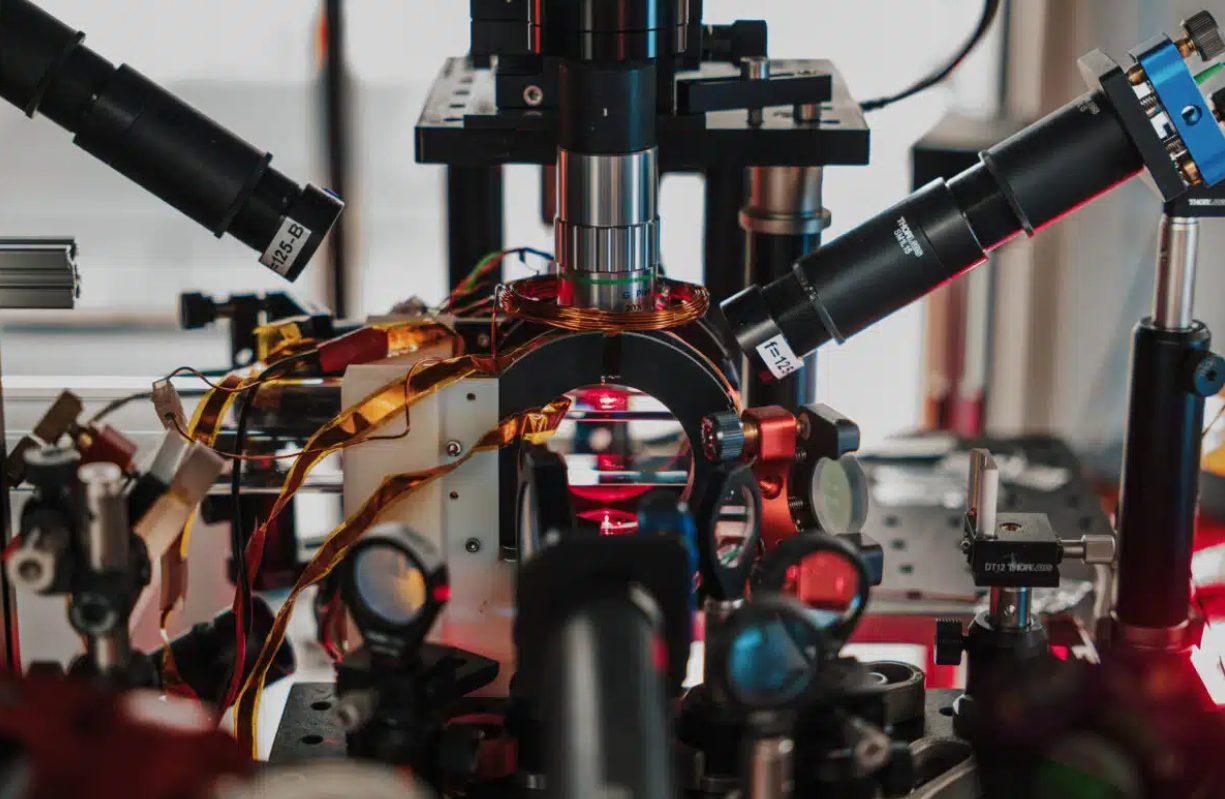
Time froze. Not in some Matrix-like Hollywood fantasy, but in a real lab at the University of Birmingham where physicist Giovanni Barontini built a miniature universe and watched it invent its own clock. Using roughly 24,000 rubidium atoms cooled to near absolute zero, Barontini created what amounts to a cosmic snow globe—complete with its own Big Bang, expansion, and Big Crunch cycles that repeat every 120 milliseconds.
The setup sounds like science fiction made concrete. Atoms get trapped by intersecting laser beams, then divided by an optical barrier into a “bright sector” you can observe and a “dark sector” that stays hidden. Think of it as a cosmic border crossing where atoms can migrate between regions, carrying entropy—basically disorder—with them.
When Internal Clocks Override External Time
Entropy flow between atom sectors creates time variable that can freeze while lab clocks keep ticking.
Here’s where things get Netflix’s “Dark” levels of weird. Instead of measuring events against a normal stopwatch, Barontini constructed an “entropic time“ based purely on how disorder flowed between his bright and dark sectors. When entropy exchanged rapidly, this internal clock raced forward. When entropy flow nearly stopped, internal time essentially froze—even though the lab’s wall clock kept ticking away like nothing happened.
The implications challenge conventional understanding. During the gaps between a mini Big Crunch and the next mini Big Bang, when no entropy flowed, literally no internal time elapsed. From the system’s perspective, those intervals don’t exist as “time passing” at all.
Testing Quantum Gravity’s Biggest Mystery
Experiment provides concrete testbed for “relational time” theories that suggest time emerges from internal correlations.
This connects to physics’ most challenging puzzle: the “problem of time.” When you try to quantum-mechanically describe the universe using equations like Wheeler-DeWitt, external time vanishes entirely. The universe exists, but without any cosmic grandfather clock ticking in the background. Barontini’s atom cloud provides a controlled testbed where time becomes relational—defined by correlations between different parts of the system rather than imposed from outside.
His mathematical model, formulated in terms of entropic time, matched the experimental data closely. That’s not just mathematical sleight of hand; it suggests this internal time construction has genuine predictive power.
The experiment doesn’t solve how time works in our actual cosmos—this mini-universe follows standard quantum mechanics, not Einstein’s full spacetime equations. But it transforms purely theoretical discussions about emergent time into something you can measure, test, and refine with real data.