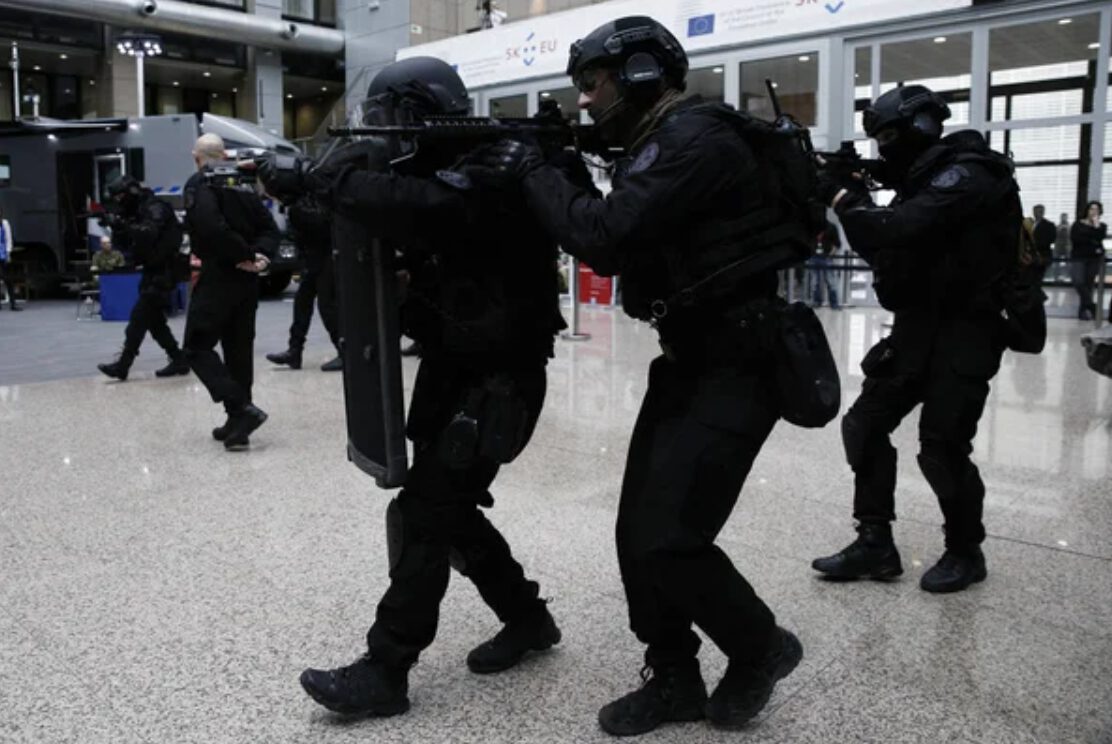
Saturday night at the Washington Hilton proved that even military-grade security tech crumbles when reality gets messy. Cole Allen, armed with a shotgun, handgun, and multiple knives, breached an outer checkpoint during the White House Correspondents’ Dinner—exposing how sophisticated detection systems fail in semi-public spaces.
The magnetometers worked perfectly. They just never got the chance to do their job.
Hotel Security’s Impossible Math
Open lobbies and VIP protection create technical contradictions that no scanner can solve.
Here’s the brutal truth about securing hotel events: your detection tech becomes worthless when the venue stays open to regular guests. The Hilton’s public areas operated with minimal screening while the ballroom maintained strict magnetometer protocols. Allen exploited this gap, bypassing the security bubble entirely.
Former Secret Service deputy A.T. Smith asked the important question: “What allowed that individual with a shotgun… to breach at least that magnetometer checkpoint?” The answer isn’t technology failure—it’s architectural reality clashing with security systems design.
The Layered Security Illusion
Multiple defensive rings sound impressive until someone walks around them.
Modern VIP protection relies on concentric security layers:
- Perimeter controls
- Screening checkpoints
- Inner sanctums
Each ring depends on the others functioning properly. Allen’s breach happened at the outermost layer, rendering every sophisticated scanner and detector downstream irrelevant.
When someone maps your defensive gaps before you do, your tech advantage evaporates.
Beyond Metal Detection
The future of event security needs smarter systems, not just stronger scanners.
This incident exposes magnetometers’ fundamental limitation: they detect metal brilliantly but can’t secure porous perimeters. Hotels with multiple entry points, guest elevators, and public spaces need integrated systems that current technology doesn’t provide.
The Secret Service’s rapid emergency response—evacuating protectees within 120 seconds and neutralizing the threat within 120 yards—showed human protocols working. But preventing the breach entirely requires rethinking venue security from the ground up.
Expect accelerated development in:
- AI-powered perimeter monitoring
- Biometric access controls
- Venue-wide threat detection systems
The Hilton incident just became every security tech company’s case study for why legacy approaches aren’t enough anymore.