Forget everything you know about solid, liquid, and gas. Researchers just predicted a completely new state of matter that operates like nothing you’ve encountered—and it could reshape our understanding of giant planets across the universe.
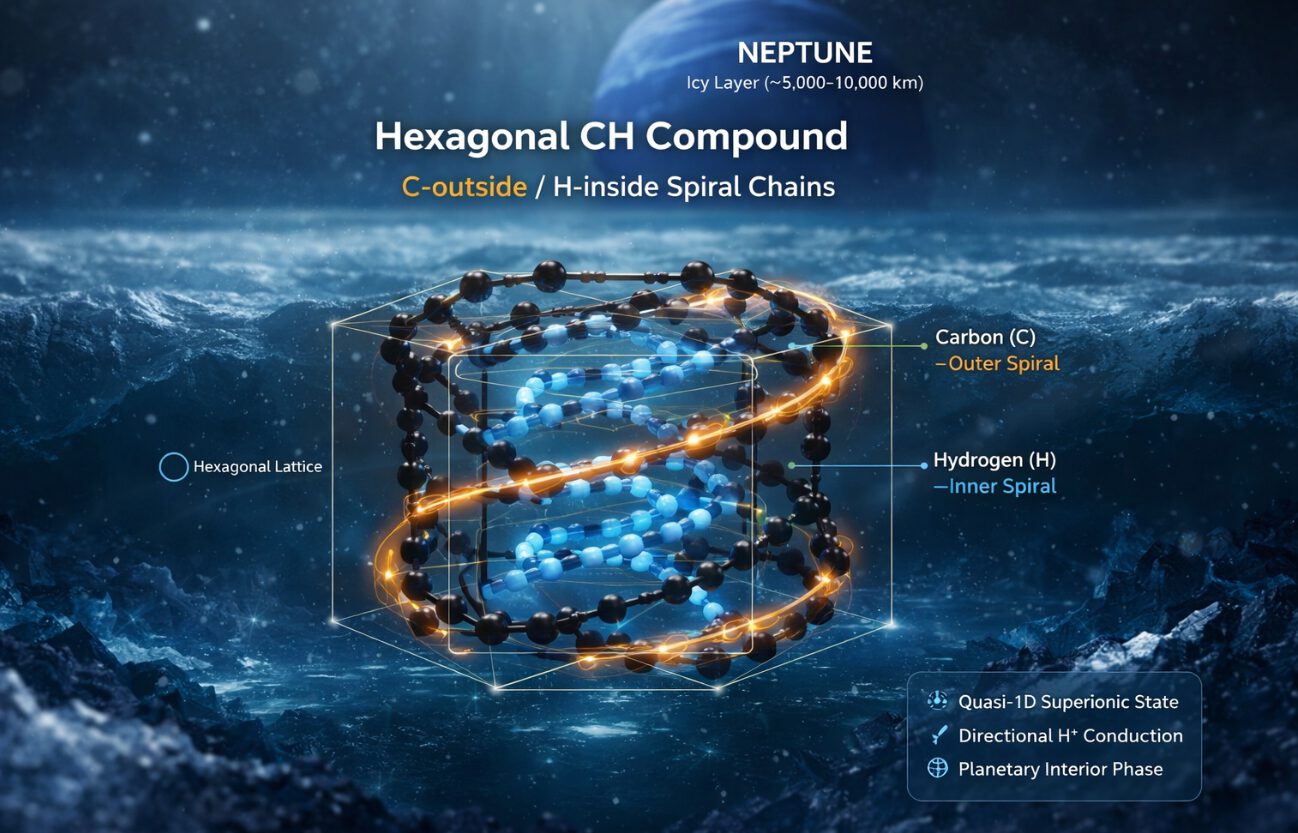
This isn’t your typical physics breakthrough gathering dust in academic journals. The discovery reveals how carbon and hydrogen atoms can arrange themselves into what scientists call a “quasi-1D superionic state“ under crushing pressures exceeding 1,000 gigapascals—conditions found deep inside massive exoplanets.
When Atoms Play by Different Rules
Carbon forms corkscrews while hydrogen slides through the lattice like rush hour traffic.
Think about carbon atoms locked into rigid, spiral-shaped frameworks resembling molecular corkscrews. Meanwhile, hydrogen atoms spin and glide primarily along a single axis, creating a material that conducts electricity and heat like a superhighway in one direction while blocking it perpendicular to that path.
“This newly predicted carbon-hydrogen phase is particularly striking because the atomic motion is not fully three-dimensional,” said Dr. Ronald Cohen, who worked with colleagues Cong Liu and Jian Sun on this computational study. Published in Nature Communications this March, their simulations reveal this exotic behavior emerges when familiar materials face the kind of extreme conditions that would make a diamond anvil cell weep.
The directional conductivity makes this state genuinely weird. Imagine a material that carries electrical current like fiber optic internet in one direction but crawls like dial-up everywhere else. That’s the quasi-1D superionic difference—a material where the very atoms follow traffic laws you never knew existed.
Giant Planet Implications
This exotic matter could explain how massive exoplanets generate magnetic fields.
“Carbon and hydrogen are among the most abundant elements in planetary materials, yet their combined behavior at giant-planet conditions remains far from fully understood,” Dr. Liu explained. While these extreme pressures exceed what exists inside Neptune or Uranus, larger sub-Neptune exoplanets could harbor this strange state in their cores.
The directional transport properties might influence how these worlds generate magnetic fields—potentially creating planetary magnetic environments unlike anything in our solar system. Think of it as cosmic-scale electrical engineering, where the planet’s interior architecture determines its magnetic personality.
Since this remains a computational prediction awaiting laboratory confirmation, researchers acknowledge the gap between simulation and reality. Diamond anvil experiments capable of recreating these pressures represent the next frontier.
The discovery expands our catalog of exotic matter states, proving the universe operates by rules that make everyday physics look quaint. As space telescopes discover more exoplanets, understanding these alien material properties becomes crucial for interpreting what we observe light-years away.