Square footage is where everyone starts, and it’s a useful number — but it’s not the whole story. The same 400-square-foot room can be a straightforward cooling job or a genuine challenge depending on where it sits in the house, how much sun it absorbs, and how well it holds conditioned air. Getting the size right means your unit runs efficiently and keeps the room comfortable. Getting it wrong means either a unit that short-cycles and leaves the room clammy, or one that runs flat-out on hot afternoons and never quite catches up.
Here’s how to figure out which size fits your situation.
Why Most Buyers Start With 12,000 BTU
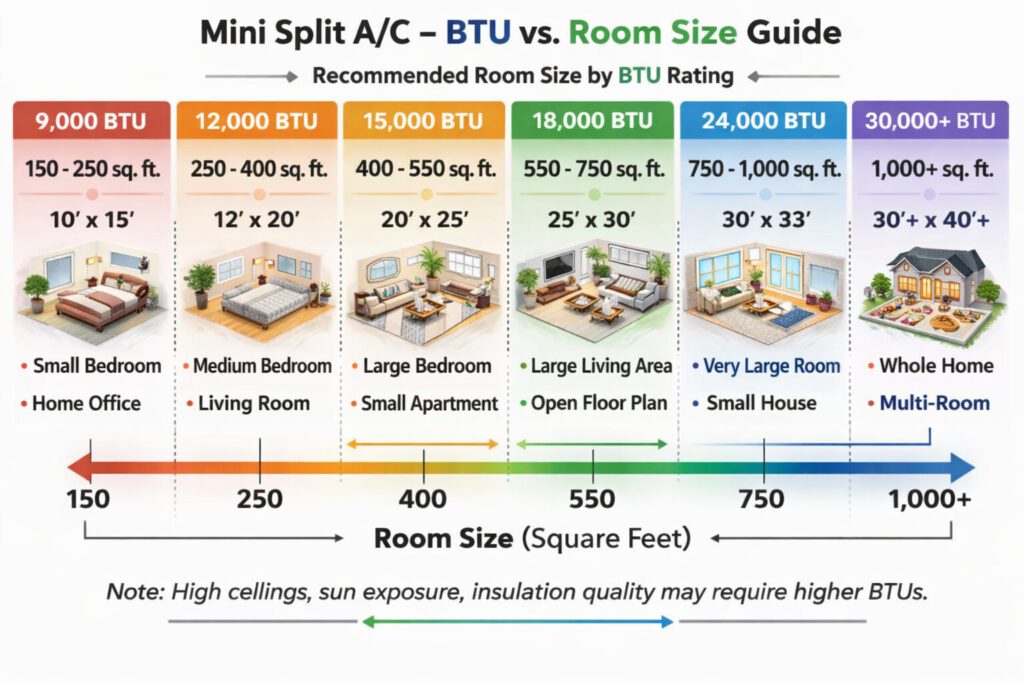
A 12,000 BTU mini split covers roughly 400 to 550 square feet under normal conditions, which puts it in range for the most common single-room setups: standard bedrooms, home offices, enclosed living spaces, and guest rooms that stay shut most of the day. It’s where most buyers land because it matches the most common problem (one enclosed room that needs its own cooling) without paying for more capacity than the space requires.
The rooms where 12k performs best share a few traits. They’re enclosed, meaning there’s a door between them and the rest of the house. They have reasonable insulation and don’t take on intense direct sunlight for hours at a stretch. Ceiling height is standard, about eight to nine feet. When those conditions hold, 12,000 BTU handles the load without working harder than it needs to.
The catch is that square footage doesn’t capture heat load. A 300-square-foot bedroom on the second floor with a west-facing window and no shade trees can run hotter than a 500-square-foot room on the north side of the house. Older homes with thin attic insulation push heat down into upper rooms all afternoon. Vaulted ceilings add volume that the floor plan doesn’t show. If your room checks more than one of those boxes (upper floor, direct afternoon sun, poor insulation, high ceiling), it’s probably carrying more cooling load than a 12k unit is built to handle consistently.
When 18,000 BTU Makes More Sense
The jump to 18k goes beyond trying to cool a bigger room; it often strays into having a harder room. One that absorbs more heat, covers more open space, or sits somewhere the building itself works against you. Large living rooms, open-concept layouts where the kitchen and dining area share airflow, garage conversions, sunrooms, and bonus rooms above unconditioned space all tend to fall into this category.
Open floor plans are a common one that people underestimate. When a living room flows into a kitchen without a wall between them, the unit is conditioning a combined space, and cooking adds real heat to that equation. A 500-square-foot living room becomes a very different cooling job when it’s actually 750 square feet of connected space with a stove running during dinner prep.
Garage conversions and bonus rooms above garages are another situation where the numbers on paper mislead. A 450-square-foot converted garage with a single layer of drywall and no ceiling insulation behaves more like an outdoor structure than a conditioned room. The same square footage that would be easy in a well-built bedroom becomes a sustained challenge when the walls and ceiling are fighting against you. In those cases, 18k is the more practical choice — not because the room is unusually large, but because the heat gain is.
A Quick Way to Decide
Rather than weighing every variable at once, eliminate the size that clearly doesn’t fit. If two or more of the following are true about your room, 12k is probably undersized: the space opens into another area without a door, you have multiple large south- or west-facing windows, the ceiling clears nine feet, or the room sits directly under the roof with no buffer. Any combination of those factors stacks heat load fast.
On the other side, if you have a standard enclosed bedroom under 400 square feet with modest sun exposure and decent insulation, 18k is more than you need. Oversizing creates its own problem, like the unit hitting the target temperature too quickly and shutting off before pulling enough humidity out of the air. This leaves the room feeling cool but damp.
The Right Size Is the One That Matches How the Room Actually Behaves
A small, well-insulated room on the shaded side of the house is a 12k job. A moderately sized open-concept space or a room that absorbs heat all afternoon is an 18k job. The square footage is your starting point, but the sun exposure, insulation, ceiling height, and layout are what actually determine which unit is going to keep up without working against itself. Get those right and you’ll have a system that runs efficiently, conditions the room properly, and doesn’t leave you wondering why it can’t keep up on a hot day.