Remote sensor failures cost companies significant resources annually, but NRD LLC claims their NBV series nuclear battery eliminates that headache entirely. The U.S.-based nuclear materials firm unveiled a solid-state betavoltaic battery powered by Nickel-63 radioactive decay, promising over 100 years of continuous power without any maintenance. That century-long lifespan ties directly to the isotope’s ~100-year half-life—though real-world efficiency, shielding requirements, and integration challenges remain unverified by independent testing.
What Actually Gets Powered
Ultra-low output limits applications to basic sensors and monitoring devices, not your everyday gadgets.
This isn’t powering your smartphone or laptop anytime soon. The NBV series delivers 5-500 nanowatts—roughly equivalent to the energy your phone uses just sitting idle for a microsecond. That microscopic output targets remote sensors, data loggers, security monitoring systems, and long-term health trackers where battery replacement proves impractical or impossible.
Think buried pipeline sensors or wildlife tracking collars, not your Apple Watch. The 20mm x 20mm x 12mm form factor makes it compact enough for integration, but you’ll need conventional batteries for anything requiring actual power.
Technical Reality Check
Voltage ranges from 1.0-20.0V with current output measured in mere nanoamps.
The specifications reveal both promise and limitations. NRD’s battery outputs 7.5-33 nanoamps at voltages between 1.0-20.0V, according to company materials. For context, that’s roughly 10,000 times less current than what powers a basic LED indicator light.
CEO Shel Alfiero emphasized preventing “mission failures in hostile environments,” while COO Kevin Heffler highlighted their licensed manufacturing and radioisotope expertise. Yet no commercial availability timeline emerged from the announcement, suggesting significant regulatory and production hurdles remain ahead.
Global Competition Heats Up
China’s Betavolt offers higher power output but shorter lifespan, highlighting different nuclear battery approaches.
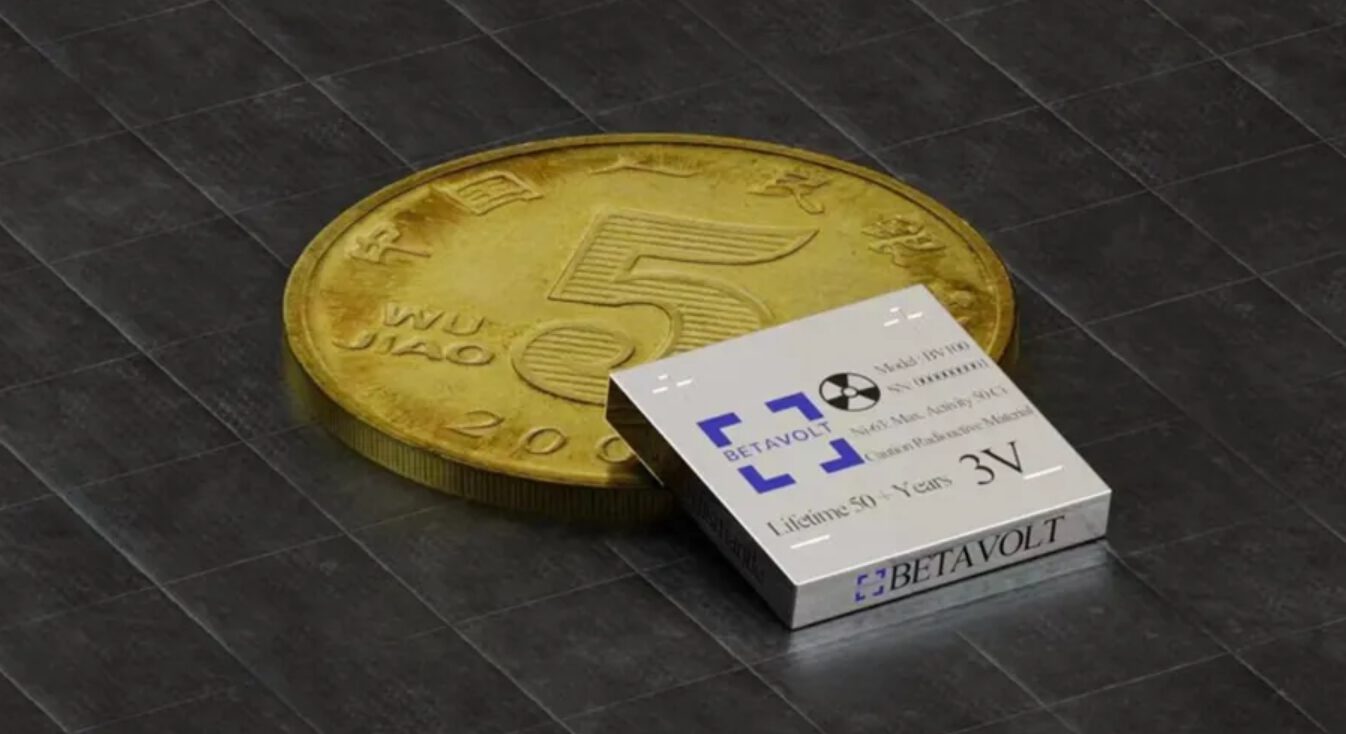
NRD faces competition from China’s Betavolt BV100, which delivers 100 microwatts at 3V for 50 years—significantly more power but half the claimed lifespan. Like comparing a Tesla Model S to a Prius, each approach involves tradeoffs between power output and longevity.
The global betavoltaic race reflects growing demand for maintenance-free power sources, though regulatory approval for nuclear materials in consumer applications remains complex. Until independent testing validates these claims and regulatory pathways clear, your devices will keep depending on lithium-ion batteries and wall outlets.