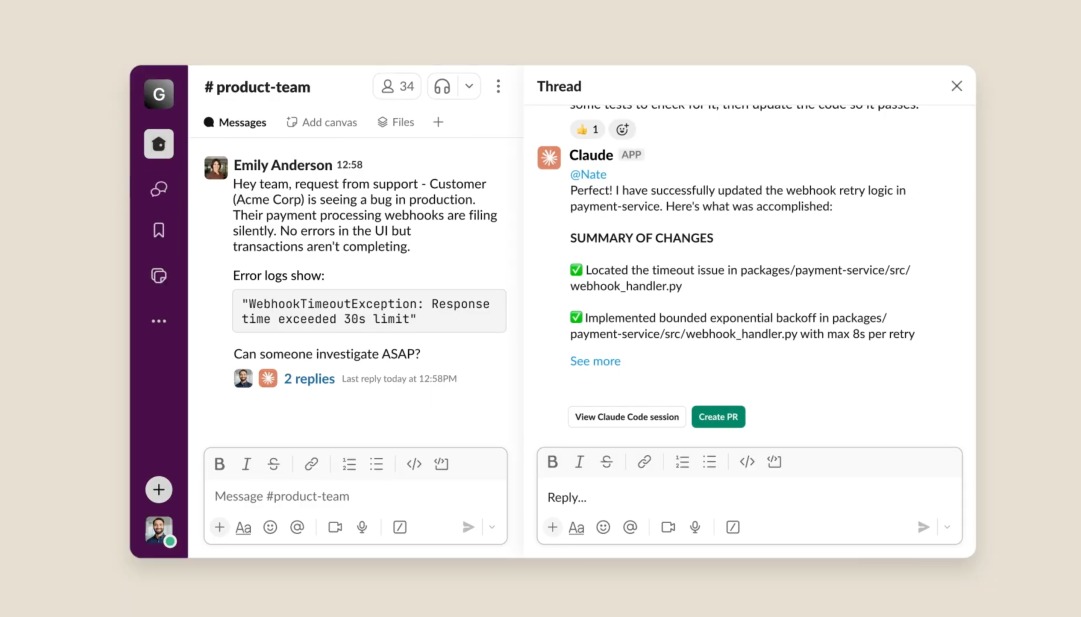
Dead phone batteries during emergencies are dangerous, but constant context switching between Slack discussions and coding work kills developer productivity just as ruthlessly. Anthropic just launched Claude Code integration for Slack as a beta research preview, letting developers @mention Claude in any thread to spin up full coding sessions without leaving the conversation.
The mechanics feel almost too smooth: Claude analyzes recent Slack messages about a bug report or feature request, identifies the correct repository, generates or modifies code, and posts progress updates in the same thread where the discussion started. When finished, it shares links to diffs and newly opened pull requests.
This extends far beyond Anthropic’s previous lightweight Slack integration that only handled code snippets and explanations. Claude Code operates as a workflow participant rather than just a glorified Q&A bot.
The Great Platform War for Developer Attention
Every major AI coding tool is abandoning IDE-only strategies for collaboration-first workflows.
GitHub Copilot, Cursor, and OpenAI Codex are all racing toward chat-based workflows like streaming services chasing the same hit show. Cursor already offers Slack integration for drafting code in message threads. GitHub Copilot can generate pull requests from chat conversations. OpenAI’s Codex powers custom Slack bots that handle code generation requests.
According to TechCrunch, this signals that “the next frontier in coding assistants isn’t the model; it’s the workflow.” Raw AI performance matters less than integration depth when developers already live in Slack for requirements gathering, architecture discussions, and decision-making.
Slack itself is pushing an “agentic hub” vision where AI agents connect to workspace data and external systems, automating everything from sales operations to engineering tasks. If successful, Claude Code becomes a strategic play for cementing Slack’s role as the primary command center for software development.
The Double-Edged Promise of Agentic Development
Productivity gains come with new security headaches and operational dependencies.
Enterprise teams evaluating Claude Code face the classic SaaS security puzzle: powerful capabilities tied to external APIs and additional attack surfaces. Repository access, permission management, and audit trails now span both Slack and Anthropic’s systems. Outages or rate limits in either service could stall workflows that were previously contained within local IDEs and on-premise tooling.
Yet the productivity promise remains compelling. Teams can move from discussing a problem to reviewing proposed solutions without anyone manually bridging the communication-to-implementation gap. The cultural implications run deeper—coding becomes a collaborative, conversational activity where AI agents post status updates alongside human teammates.
If you’re managing engineering teams, Claude Code represents more than convenient automation. It’s a preview of workflows where conversations become the single source of truth for both decisions and implementation progress, with AI handling the mechanical translation between discussion and code.