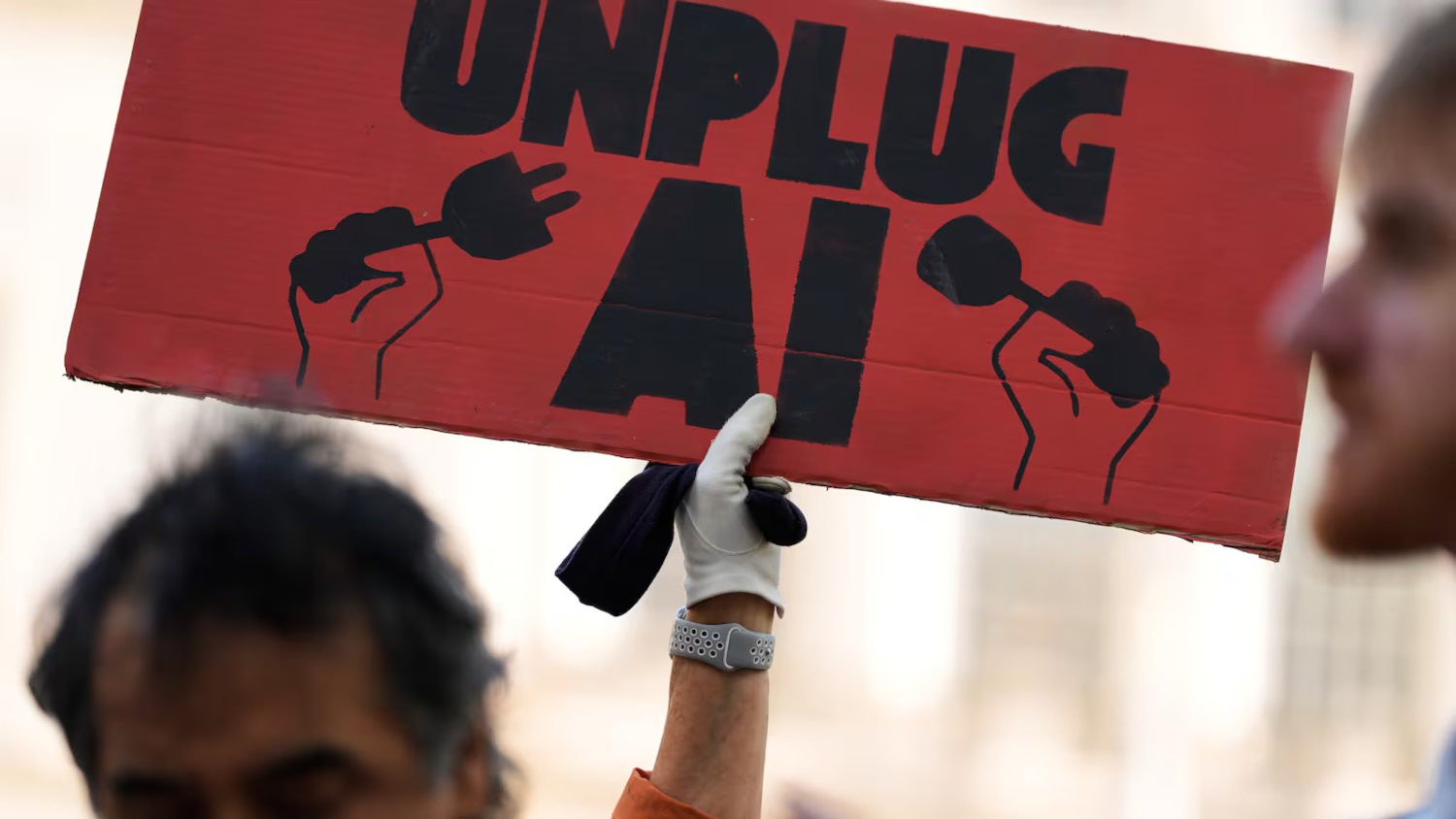
Students at MIT, Harvard, Northeastern, Boston University, Wellesley, UMass, and Tufts plan to leave their classrooms Tuesday to demand a pause on the technology reshaping nearly every sector of public life, including data centers consuming water and electricity at unprecedented scale.
Organizers plan to gather students and community members outside the Massachusetts State House on Oct. 20 from 1 p.m. to 3 p.m.
The Ask Is Blunt: Stop Building Until Society Catches Up
Organizers want a national freeze and genuine public participation in AI governance, not a seat at an advisory panel with no binding authority.
Students from the named campuses are expected to gather outside the Massachusetts State House on Tuesday, Oct. 20, from 1 p.m. to 3 p.m., according to Boston 25 News. The action is organized locally by the Massachusetts AI Action Network and is part of a national “Freeze AI” campaign sponsored by Irreplaceable.
Organizers say the central demand is straightforward: a national freeze on advanced AI development, paired with meaningful public participation in decisions about how that technology is built and governed. Per Irreplaceable’s event page, organizers argue those decisions currently rest with technology executives rather than the public, and that arrangement falls short of meaningful democratic accountability.
Speakers at the State House are expected to address job displacement, economic disruption, environmental costs, and public safety. The available sources do not specify a proposed bill or regulatory text; the legal scope of the requested freeze remains undefined in organizers’ public materials.
Who’s Walking Out, and Who Organized This
Seven campuses are named by organizers, but confirmed university endorsements are absent from available reporting.
Per Irreplaceable’s event directory, participating or planned walkout locations include Boston University, Northeastern, UMass Boston, MIT, and Wellesley. Organizers also cite Harvard and Tufts among expected participants, according to Boston 25 News. That list is organizer-attributed; the available reporting does not confirm official endorsement from any of the named institutions.
The Massachusetts AI Action Network is coordinating the Boston action as part of Irreplaceable’s broader national campaign, which includes events in multiple U.S. cities. A related press conference is planned in Lexington, Kentucky, a detail that places the Boston walkout within a wider civic campaign rather than a single-campus dispute.
The Uncomfortable Truth Behind the Walkout
Organizers are responding to a real gap between how fast AI capabilities have grown and how slowly oversight structures have followed.
Some of the campuses named in the walkout also contribute research and talent that advance the field organizers want paused. That tension is worth noting, though students demonstrating near their own institutions have a long and legitimate tradition of doing exactly that.
What organizers are responding to is a documented gap. AI capabilities have scaled faster than safety research and faster than regulatory frameworks. Data centers built to run large language models consume water and electricity at a scale that communities near major facilities have already begun to notice, according to published reporting on the data-center expansion. Neither the named universities nor any major AI companies provided responses in the Boston 25 report; their positions in the available public record remain unconfirmed.
What a Real Answer Would Look Like
The demonstration raises a question that a freeze alone cannot answer: what accountability structures should replace the current approach?
Whether a blanket development freeze is achievable or even desirable is a legitimate policy debate, and Tuesday’s demonstration will not resolve it. What the walkout does signal is that AI governance has become a campus and civic issue, carrying a different kind of pressure than a conference panel or a congressional hearing.
Meaningful oversight would require mandatory safety evaluations before deployment, enforceable transparency standards, and public processes with genuine decision-making authority. Those are not science-fiction demands; they are the kinds of structures other consequential industries were eventually required to build.