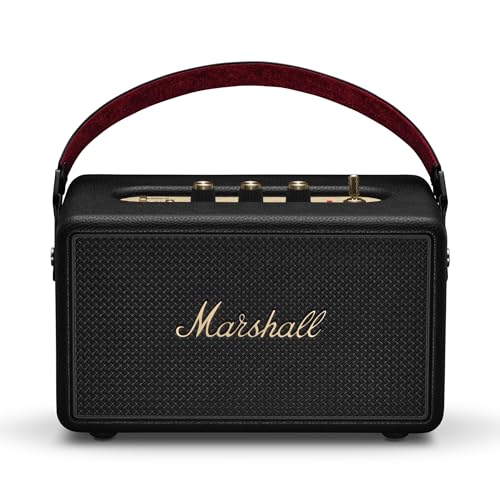




How does it perform?
The Marshall Kilburn III delivers where it matters most for a mid-sized portable speaker: legitimate 50-hour battery life confirmed by testing, powerful 91 dB SPL output at 1 meter, and bass extension measured down to 45Hz. In one test, 8 hours of continuous playback at 1/3 volume knocked the battery to only 85%, which translates to roughly 53+ hours to get it to zero. Real-world users reported week-long usage at over 50% volume. The speaker gets genuinely loud without distortion, too, and eviewers noted minimal distortion even at high volumes. Independent testing confirmed 45Hz-20kHz frequency response, which means it has good bass in the lows and sparkle in the top-end.
What’s it do best?
The Kilburn III excels at sustained high-volume playback without battery anxiety or sound degradation. That tested 50+ hour battery life means multi-day trips, weekend parties, and week-long daily use between charges. The 91 dB SPL @ 1m output delivers room-filling sound, something that Tom’s Guide noted as “mind-blowingly loud”. It also sounds great, with Headphonecheck calling it “the best sound I’ve heard in this speaker size class” with consistent performance at both low and high volumes.
Audio Performance Quality
Frequency Response Range
Frequency coverage determines how much of the music you actually hear from deep bass to airy highs.
Measured Range: 45Hz – 20kHz
Real-World Assessment: Powerful, well-controlled bass with tight low-end and clear mids
Son-Vidéo measured bass extension down to 45Hz during frequency sweep testing. Louder tested Royal Blood’s “Out Of The Black” and documented “tight, precise low end that hits hard without wobbling rhythm.” Yungblud’s “Lowlife” opened with “convincing sub-bass.” However, Son-Vidéo noted bass accentuation on complex tracks that occasionally unbalances the mix.
Total Harmonic Distortion (THD)
Distortion measurements reveal how cleanly a speaker reproduces sound across volume levels.
Moderate Volume: Minimal distortion, clean reproduction
High Volume (80-100%): Maintains stability, no significant distortion
The Kilburn III maintains clean reproduction across its volume range. TechRadar noted “impressive balance across frequencies even at louder volumes” and confirmed “pleasing, distortion-free sound” during testing. Tom’s Guide tested progressive metal Ne Obliviscaris’ “Equus” at high volume and reported “impressive volume with intricacies extremely well represented” with clear vocals cutting through layered guitars. HomeCineSolutions confirmed the speaker achieves “91 dB SPL at one meter, allowing for high-volume listening without noticeable distortion.”
Maximum Output and Sensitivity
Sound pressure capability determines loudness potential and room-filling ability.
Measured Output: 91 dB SPL @ 1 meter
Marshall rates the Kilburn III at 91 dB SPL measured at 1 meter distance. Tom’s Guide confirmed it “gets mind-blowingly loud” and “fills large rooms with very little effort.” Son-Vidéo testing documented the speaker can fill rooms up to 30 square meters, and one reviewer noted it’s “unbelievably loud” for a solo device.
Sound Character and Tuning
The “character” defines the overall tonal balance and sonic personality of the speaker.
Sound Profile: Bass-forward Marshall signature with rich mids and controlled highs
Strengths: Deep, tight bass; forward, textured vocals; clean instrument separation; adjustable via physical controls
Weaknesses: Bass can dominate on complex tracks; slightly restrained treble requires manual adjustment; mono playback (stereo requires two units)
The Kilburn III delivers Marshall’s signature sound: emphasized bass foundation without bloat, forward midrange for vocals and guitars, slightly restrained treble that prevents harshness. Headphonecheck praised “deep, tight, and impactful bass giving solid foundation to rich, detailed mids where vocals and instruments shine.” Louder’s testing with Alice Cooper’s “Up All Night” revealed “vocals sit forward and textured” with “tight snare hits and guitars feel authentically greasy.”
The dedicated bass and treble knobs provide immediate tonal adjustment. Son-Vidéo noted the bass accentuation “can sometimes cause imbalance on certain more complex tracks” but confirmed “this is not a serious problem, as the speaker features two tone controls.”
Stereo Imaging and Soundstage
Soundstaging describes the speaker’s ability to create spatial separation and imaging.
Driver Configuration: Wide soundstage with consistent delivery across listening angles
Limitation: Some detail loss when standing to side or behind speaker
Marshall’s True Stereophonic technology aims for omnidirectional audio with no blind spots. Tom’s Guide described the soundstage as “alarmingly wide and 3-dimensional” with “stereo effect” from drivers pointing multiple directions. TechRadar confirmed “clear, powerful audio no matter where you’re standing” during walk-around testing. However, Son-Vidéo noted that “in reality some details are lost when you’re standing to the side of or behind the speaker” compared to frontal listening. The wide imaging works best in medium-sized rooms where the 360-degree propagation can reflect off walls.
Connectivity Performance
Bluetooth Range
Wireless range determines usable distance between source and speaker.
Rated Range: 10 meters (33 feet)
Real-World Performance: Rock-solid connectivity with no dropouts
Standard Bluetooth 5.3 provides 10-meter range specification. Customer reviews highlighted “rock-solid connectivity with no interference or dropouts” even when moving around outdoor spaces. The Bluetooth 5.3 LE Audio implementation supports lower power consumption while maintaining connection stability.
Audio Latency
Latency measures delay between video and audio output.
Video Streaming: Relatively low latency, suitable for video content
Testing confirmed acceptable latency for video streaming, though specific millisecond measurements weren’t published. Reviewers noted no lip-sync issues when testing with TVs. The lack of aptX Low Latency codec means gaming applications may experience some delay, but casual video watching performs fine.
Pairing Speed
Connection speed impacts everyday usability.
Setup Time: Quick and easy on both platforms
Google Fast Pair delivers one-tap connection for Android devices. Standard Bluetooth pairing works efficiently on iOS and other platforms. The speaker remembers multiple devices via multipoint support.
Codec Support Quality
Codec support determines wireless audio fidelity and compatibility.
Supported Codecs: SBC, AAC, LC3 (Bluetooth 5.3 LE Audio)
Notable Absence: No aptX, aptX Adaptive, or LDAC
The Kilburn III supports basic SBC, AAC (good for Apple devices), and modern LC3 codec for LE Audio efficiency. Multiple reviewers noted the lack of aptX and LDAC codecs limits high-resolution streaming potential for Android audiophiles. The LC3 codec provides improved efficiency over SBC but doesn’t match aptX Adaptive or LDAC quality.
Connection Stability
Stability assesses consistent wireless performance without dropouts.
Real-World Testing: “Rock-solid” connectivity according to experts
Customer feedback consistently praised connection reliability alongside the experts. One reviewer noted connectivity stayed solid even when moving around outdoor spaces.
Power Management and Battery Performance
Battery Capacity and Duration
Battery life determines usable time between charges across different volume levels.
Real-World Testing (1/3 volume): 53+ hours extrapolated from 8-hour test with 85% remaining
Real-World Testing (50%+ volume): Week-long daily use without charging
Tom’s Guide ran 8 continuous hours at 1/3 volume and measured 85% battery remaining, extrapolating to 53+ hours at that level. The tester noted “1/3 volume is plenty loud enough.” BGR’s reviewer used the speaker all day for work, in the shower, and while cooking, reporting “more than a week on a single charge” at over 50% volume. One customer documented usage through “two days in Florida, the drive back home, and then another five days” without recharging.
Charging Performance
Charging speed impacts downtime between listening sessions.
Full Charge Time: 3 hours with 30W USB-C PD charger
Real-World Testing: 2.5 hours with 45W+ charger
Multiple sources confirmed 3-hour charging time with appropriate 30W USB-C PD power supplies. Marshall official support recommends avoiding fast chargers when possible, as “fast charging causes stress on the battery and will degrade it.”
Fast Charging Capability
Quick charging enables extended use from brief charging sessions.
Real-World Testing: 8 hours playback from 20-minute charge
Crutchfield confirmed “quick charging capability provides up to 3 hours of playback with only a 20-minute charge,” while multiple other sources documented 8 hours from 20 minutes. The USB-C PD implementation provides meaningful emergency power boosts during travel or gatherings.
Build Quality and Durability
Water and Dust Resistance
IP54 rating defines environmental protection limits.
IP Rating: IP54 (dust protection, splash resistance)
Not Protected Against: Submersion, jet spray, heavy rain, saltwater
Real-World Use: Suitable for casual outdoor use, bathroom, poolside (not in pool)
The IP54 certification means dust protection (5) and splash resistance from any direction (4). TechRadar noted this represents “significant improvement” over the Kilburn II’s IPX2 rating. The speaker handles bathroom steam, light rain, and poolside splashes but should not face submersion or heavy weather like IP67-rated competitors.
Setup and Usability
Control Interface Design
Physical controls provide immediate adjustment without app dependency.
Tactile Quality: “Clicky toggles, tactile knobs, rock-solid main switch” (Headphonecheck)
Visual Feedback: 10-segment battery indicator, deep-red LED rings around knobs
The brass control panel with physical knobs earned universal praise. Headphonecheck noted operation “feels like handling vintage gear.” Tom’s Guide called the controls “user-friendly” with “illuminated markers.” The immediate tactile response beats app-only interfaces for real-time adjustments. However, some reviewers noted LED indicators can be dim in bright outdoor sunlight.
Software Integration
The Marshall Bluetooth app provides sound customization and device management.
App Features: Five-band EQ, placement compensation DSP, firmware updates, battery preservation controls
Limitations: No playback controls, limited multipoint device management
The Marshall app offers five-band EQ for detailed sound shaping and Placement Compensation that adjusts frequency response for near-wall or free-standing positions. Battery preservation features include charge speed limiting and 90% maximum charge cap. Can Buy or Not noted “the app is limited” with “playback control functionality noted as limited” and no multipoint device management is available.