
Choosing the best TV for bright rooms boils down to one essential capability: overcoming light, be it direct or indirect. This becomes particularly crucial in settings where controlling lighting is a challenge, such as rooms with TVs placed next to windows or under skylights. In these scenarios, the glare from direct sunlight or the brightness from ambient indoor lighting demands a great TV that excels in both HDR and SDR performance, coupled with superior reflection handling.


TL;DR
When you shop through our links, you’re backing our mission.
The choice of technology plays a significant role here. OLEDs, for instance, are less suitable for such brightly lit environments due to their lower brightness levels. Instead, LED and QLED TVs emerge as the ideal options. Keep reading to learn what test criteria and specifications help us determine the best bright room TVs.
⚒️
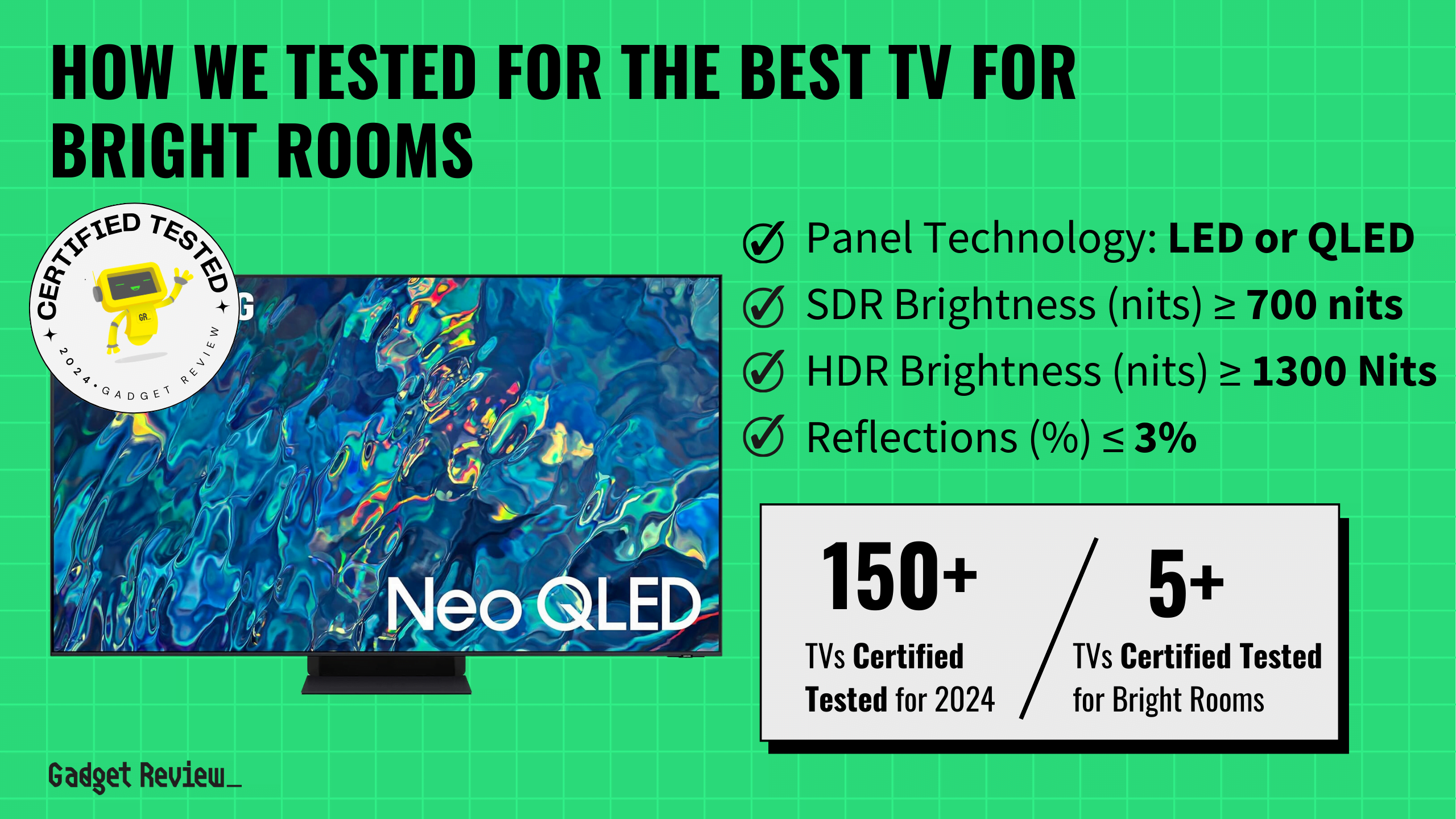
Minimum Specifications for the Best Bright Room TV
- Panel Technology: LED or QLED, as OLED is not suitable for bright room conditions.
👍
“Nice To Haves” for the Best Bright Room TV
- Refresh Rate: A high refresh rate, like 120Hz, is crucial. It ensures smooth motion and clear visuals, particularly in dynamic scenes, which is a significant advantage in bright rooms.
- HDR Format Support: HDR is about bringing depth to your picture with enhanced contrast and richer colors. It’s key to making every scene pop, especially in rooms filled with natural or artificial light.
🧪
Test Criteria for the Best Bright Room TV
- SDR Brightness: SDR brightness evaluates the TV’s performance in standard settings. The ability to display higher brightness is essential for combating ambient light in bright rooms.
- HDR Brightness: HDR brightness assesses the TV’s peak brightness capabilities, which are crucial for maintaining contrast and detail in well-lit areas.
- EOTF (Electro-Optical Transfer Function): The EOTF is crucial for ensuring the TV accurately reproduces a range of brightness levels, contributing to a balanced and realistic picture in various lighting conditions.
- Reflectivity: While not a test criterion that was make or break for the TVs on the list, reflections are still an important aspect of any television that’s going to be in a brightly lit room. Highly reflective screens introduce tons of glare that ruins picture quality or even makes your TV outright unwatchable.
Our selection process is thorough and data-driven, ensuring that the TVs we recommend can meet the demands of bright environments. We scrutinize and validate our choices, aiming to help you find a TV that not only suits your space but also enhances your viewing experience, no matter the lighting challenges you face. It’s these specifications and test criteria that led us to the Samsung QN95B Neo QLED, where it sits at the top of our list for the best TVs for bright rooms.
Latest Updates
- 01/30/2024: Completely and thoroughly overhauled the guide to include the best and latest bright room TVs.
- 11/21/2023: Republished the list to include TVs based on our True Score system.
Our commitment to unbiased reviews is powered by our ‘True Score’ system, targeting low quality and fake reviews. Commissions fund this mission. No bias. No BS. Learn more
Top Bright Room TVs For 2026
Prices accurate at the time of publishing
You won’t find any OLEDs on this list (not yet – OLEDs are getting brighter every year) but that’s the only spec that really matters when it comes to beating back the sun shining through a window onto your TV.

Best Overall

Runner Up

Best Value

Best Budget

Best Mid-Range

Premium Pick
What Are The Top 6 TVs for Bright Rooms?
True Score
Experts
Customers
Cosmic Wonder

Absolutely Fresh

Mixed Reviews

Meh

Read More
Snapshot
Reasons to Buy
Reasons to Avoid
Specifications
All Specs
Test Results
All Tests
All Retailers
Our Verdict
Read Less
Category Snapshot
TVs
DON’T SEE WHAT YOU’RE LOOKING FOR?
Be sure to also read our guide to the best TV brands. Or if you have a particular use case check out the best gaming TVs, best OLED TVs or the best TV for sports. You can also check out the best 8k TVs, which offer exceptional clarity, and consider the differences between 4k vs 8k. And if you’ve already bought a soundbar, read our guide on how to connect a soundbar to your TV.

DID YOU KNOW 87% OF TV REVIEWERS ARE UNTRUSTWORTHY?
Our research found 28 of 210 TV reveiwers can be trusted, and shockingly 1 out of 3 on Google Page 1 were fake reviews showing no proof of test claims. See our Expose and Trust List. This is why Gadget Review is committed to calculating the most accurate product scores on the web.
To do this, we give every TV review site a Trust Rating, which measures how trustworthy the site and their testing claims are. We then leverage AI & a machine learning model to combine and calculate the Trust Rating with data from experts and consumers to deliver the True Score, the web’s most accurate product quality rating.


Our Approach to Testing Bright Room TVs
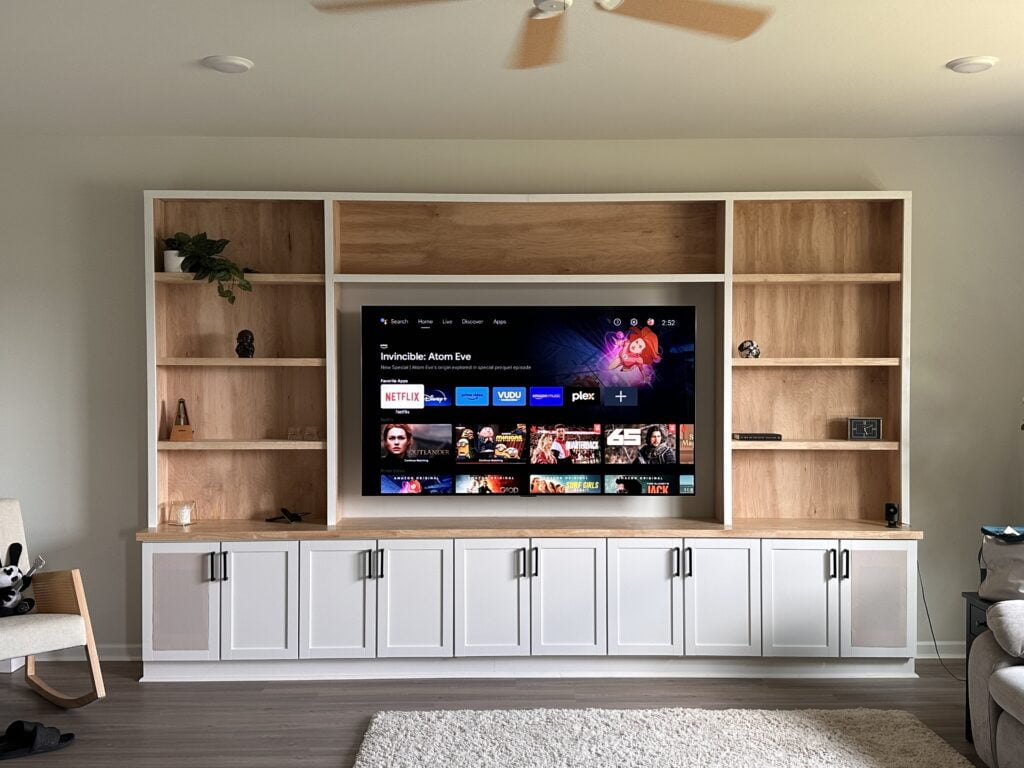
Evan Shepard/Gadget Review
Our approach to “testing” is vastly different than any other website on the Internet today. While we do some in-house testing to verify reviews, our bright room TV data set is constructed from other trusted sites testing and running benchmarks on HDR, SDR, reflections and more.
We collect this data so you don’t have to, simple as that. We then average that testing data to represent that product’s capabilities accurately. Subsequently, we then leverage that data, filter and sort our buying guides, ensuring that all the products on our guides meet the strict requirements for your use case, such as watching a TV in a brightly lit living room or kitchen.
You may notice some of our graphs contain “Source: RTings”. This is to indicate that the data we’re showing off in a graph has come from a single source – because it’s the only source that actually tested the criteria and had data for it! Normally, our data is an average out of all of the various publications that test and provide data to give you a good idea of how a product is going to perform on average.
Which Criteria Matter for Testing Bright Room TVs?
By focusing on these criteria (3 required, 1 nice to have), anyone can quickly and easily compare TVs and how they perform in bright rooms. This helps you make an informed decision and pick a TV that delivers the brightness levels you need to overcome even the brightest rooms in the house.
| CRITERIA | RANGE | REQUIRED | DEFINITION |
|---|---|---|---|
| SDR Brightness | 700+ nits | Yes | Measure how luminous your screen is in SDR mode |
| HDR Brightness | 1300+ nits | Yes | Measure of how luminous your screen is in HDR mode |
| Reflections | <= 3% | Yes | Measures what percent of light is reflected off the screen when subjected to light |
| EOTF | <= 0.06 (600 nit Δ) | No (nice to have) | Standard that governs how your display interprets and renders brightness and color |
Our Trusted Data Sources
(Publication category Score is 80%+)
We looked at 210+ TV reviewers and while 24 are trustworthy (60%+ Trust Rating), we only use data from the testers that are “very trusted” which means a Trust Rating above 70%. The three we have listed below are our most trusted for TVs, along with our own in-house TV expert.
- Evan Shepard – Gadget Review
- Matthew Lopes – RTings, MuckRack
- Will Greenwald – PCMag, MuckRack, Twitter
- David Katzmaier – CNET, MuckRack, Twitter
Interested in a comprehensive analysis of our data sources? We’ve got you covered. Below, you’ll find a detailed list of every TV review website we’ve identified, organized by their respective Trust Ratings from highest to lowest. But we didn’t stop there. We’ve meticulously reviewed each publication and verified the data by checking whether the authors have bio links to MuckRack or LinkedIn. We’re committed to not only checking the facts but ensuring their veracity.
TV Test Data & Results
1. SDR & HDR Brightness TV Test Results
Brightness
SDR: 700+ nits
HDR: 1300+ nits
Acceptable range of performance
Definition: Maximum brightness in a specified pattern size window. Most commonly measured in a 10% or 100% white window.
Units of Measurement: nits (alternatively cd/m²)
Tools to Measure: TV, luminance meter
Why It’s Important:
Brightness helps counter ambient light so that details and colors don’t wash out and get lost.
Poor brightness in rooms that have lots of ambient light leads to multiple problems. Not only can the picture be completely lost in the light and reflections off the screen, what picture does manage to shine through will likely be washed out, suffering bad contrast and poor details.
Unlike other use cases, where brightness is welcomed but not mandatory, the more nits your TV can pump out, the better in a bright room scenario. For SDR content, 700 nits is the minimum but more is always welcome, and some of the brightest sets can reach north of 1500. With HDR content, at least 1300 nits is necessary, but some of the TVs sitting at the top end reach past 2000!
SDR Brightness (in nits, higher is better)
HDR Brightness (in nits, higher is better)
2. Reflections Test Results
Reflections
< 3%
Acceptable range of performance
Definition: How much light is reflected off the screen when it is subject to direct and indirect light.
Units of Measurement: This text measures how much light is bounced off as a percentage of total light
Tools to Measure: Sampling sphere
Why It’s Important:
The light a TV reflects makes it harder to see what’s happening. Lower reflectivity translates directly to a better viewing experience, especially in rooms with bright natural or artificial lights.
TVs designed with good reflections handling feature anti-reflective coatings or panel technologies that minimize the impact of ambient light. This ensures that the image remains clear and vibrant, preserving detail and color accuracy even when faced with direct light sources. It’s a key consideration for anyone looking to place their TV in a sunlit living room or a well-lit space where control over lighting conditions might be limited.
Choosing a TV with superior reflections handling translates to a more versatile viewing experience, allowing you to enjoy sports, movies, and other content without having to draw the curtains or adjust room lighting. It’s an essential feature for ensuring that your TV can deliver optimal performance across a wide range of lighting environments, enhancing overall viewing pleasure.
Reflections Handling (lower is better)
Data Source: rtings.com
3. EOTF Test Results
EOTF
<= 0.06 (600 nit Δ)
Acceptable range of performance
Definition: How your TV interprets and renders the luminance data from content and translates it to be represented on screen.
Units of Measurement: this test measures for the delta from the standard
Tools to Measure: Luminance colorimeter
Why It’s Important:
If EOTF/Gamma tracking is too low or too high, it will result in an over-brightened or over-darkened image from reference. Since the TV is fighting ambient light, overcorrecting can reduce image quality.
EOTF (electro-optical transfer function) ensures that content is displayed as intended when it was originally mastered.
In bright environments, maintaining consistent and true-to-source brightness levels is vital. A well-calibrated EOTF ensures that the TV displays a balanced range of brightness, from deep blacks to bright whites, without losing detail. This accuracy is especially important in brightly lit rooms, where ambient light can wash out images.
A TV that precisely handles EOTF (Electro-Optical Transfer Function) can provide a more realistic and immersive viewing experience. It accurately represents the content as intended by its creators, even under challenging lighting conditions. From landscapes to the most explosive action scenes, everything is displayed with the correct luminance and contrast.
EOTF (lower is better)
Data Source: rtings.com
Bright Room TV: Mistakes To Avoid
- Ignoring Room Layout: When you’re placing your television, be it on a stand or mounted up on a wall, it’s important to keep in mind exactly where it’s going. Some walls may sit opposite of windows where the sun shines right through, which makes it all the harder for you to see your TV. While a TV that’s suited for bright rooms is intended to help counter bright light, it’s important to give the set the best chance it has at taking advantage of its brightness.
- Blindly Choosing OLEDs over LEDs (or QLEDs): There’s nothing wrong with OLED TVs. They’re on the cutting edge of TV panel technology and have the best contrast, picture quality and blacks of any TV panel on the market. OLEDs are also still universally dimmer than the brightest LEDs and QLEDs 4K TVs (read: 4k vs 1080p), which makes them less than ideal for bright rooms (though this will likely change in the very near future). Stick with the brighter panels if you’re fighting ambient light, even if it means losing out on some picture quality and contrast.
- Ignoring Reflectivity: TV screens reflect light, just like phones and computer monitors. Part of fighting reflections starts with putting a TV in the right spot – which means not putting it in direct sunlight. You can further position a TV to help reduce glare, but sometimes no matter where the TV goes there’s going to be glare and low reflectivity helps counter it.
- Overlooking Other Use Cases: A TV is used for more than just bright rooms. Consider how well the TV performs when viewing different types of content like video games, movies, live sports, and regular TV shows. Check for good color accuracy, viewing angles, smart features, and sound quality, therefore ensuring a well-rounded performance.