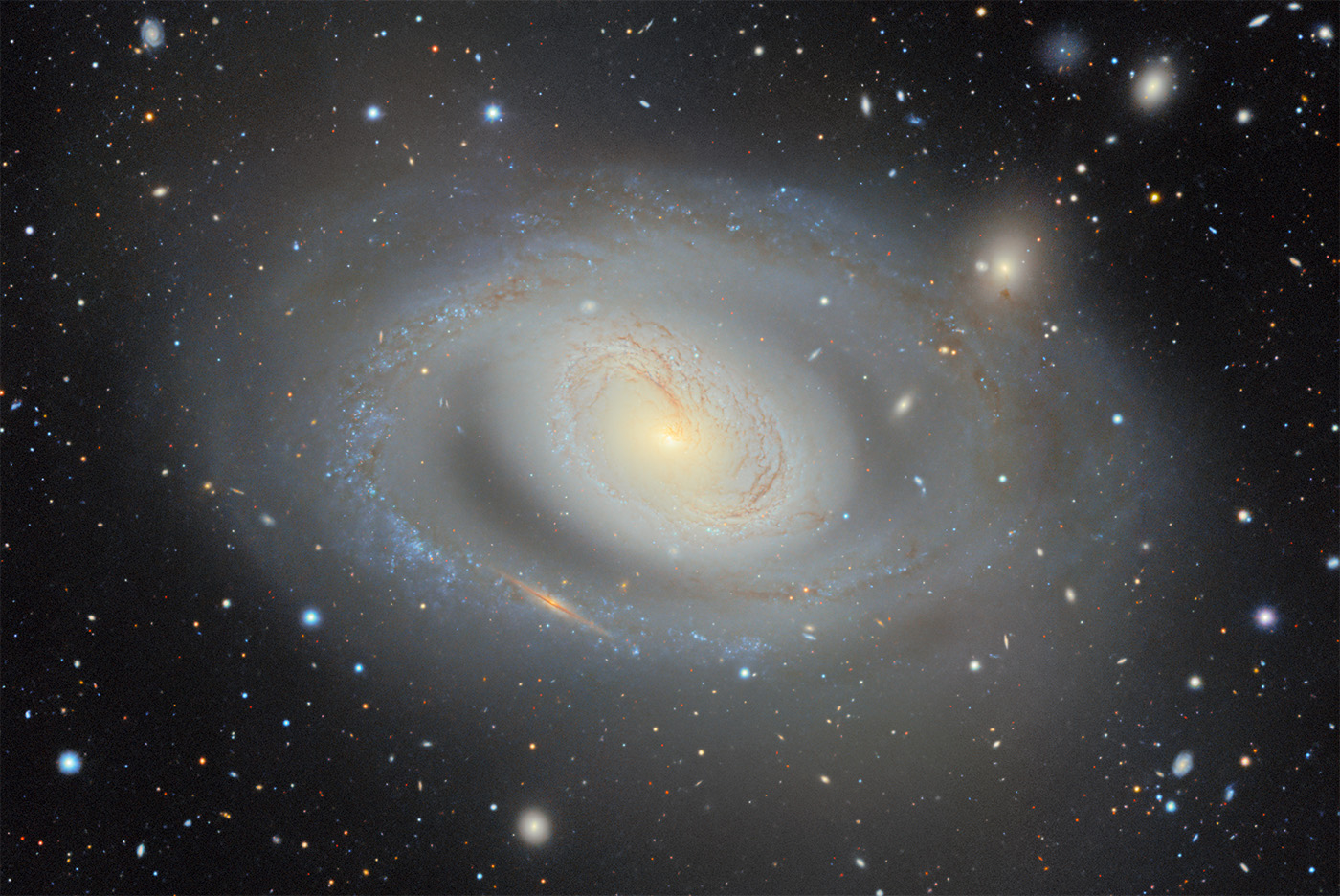
Five-point-six trillion pixels. Nearly 4 billion celestial objects. Three-quarters of the sky stitched into a single, publicly accessible image. The DESI Legacy Imaging Surveys team has released the largest 2D color map of the universe ever assembled — and the genuinely surprising part isn’t the scale. It’s that you can open it right now in a browser and start scrolling.
Thirteen Years of Sky, One Massive File
This dataset took longer to build than most careers — and the numbers back that up.
Three ground-based surveys contributed the raw material: the Dark Energy Camera Legacy Survey (DECaLS), the Mayall z-band Legacy Survey (MzLS), and the Beijing-Arizona Sky Survey (BASS). Together they produced 263,407 telescope exposures over 13 years, supplemented by NASA’s WISE satellite data and processed at the National Energy Research Scientific Computing Center (NERSC). The result covers roughly 75% of the sky in visible and near-infrared light, deliberately focused on regions where Milky Way dust doesn’t block the view.
The numbers that follow are worth sitting with:
- 5.6 trillion pixels; nearly 4 billion celestial objects catalogued
- Covers approximately 75% of the sky in visible and near-infrared light
- Earlier Legacy Survey data already cited in more than 1,800 scientific papers
- Publicly viewable right now via the Legacy Survey Sky Viewer
- Built to support DESI’s 3D spectroscopic survey target selection
According to NOIRLab, David Schlegel described the viewer as now part of “the fabric of astronomy research.” That’s not hyperbole — it’s infrastructure.
The Map Behind the Map
Two dimensions come first; three dimensions follow — that’s how modern cosmology actually works.
Think of this 2D map the way you’d think of a satellite base layer in Google Maps. Every future observatory needs something to compare against. This is that layer. The map tells astronomers where objects are and how bright they look. DESI then uses that information to select targets for its spectrograph, which measures distances and builds a 3D picture of the universe’s large-scale structure. This map made that targeting possible.
The dataset’s future utility reaches further still. Researchers plan to use it to hunt rare gravitational lenses and supernovae, study how galaxies evolve, and — critically — train AI tools for the Vera C. Rubin Observatory and the Nancy Grace Roman Space Telescope as those facilities come online. A baseline this deep and wide doesn’t just serve current science. It anchors the next decade of it.
As Arjun Dey of NOIRLab put it: “the skies belong to everyone.”
You don’t need credentials to open the Legacy Survey Sky Viewer and scroll through 4 billion objects. The science is elite. The access isn’t. When Rubin and Roman begin delivering their own flood of newly catalogued objects, they’ll need exactly this kind of foundation to make sense of what they’re seeing.